I. Parts of a Plane Figure
A point in geometry is a location. It has no size i.e. no width, no length and no depth. A point is shown by a dot.


A part of a line that has defined endpoints is called a line segment. Where a line extends infinitely in both directions a line segment is limited on both ends by the end points.

A line segment can be written as:

A ray starts at one point and continues on forever in one direction.

A ray can is written as:

II. Angle Introduction
An angle is formed when two straight lines or rays meet at a common endpoint. The common point of contact is called the vertex of an angle.
This figure is made up of two rays and . The common end point of two rays is called the vertex of the angle. So, O is the vertex of angle AOB.
The rays and are called the arms or sides of angle AOB.
An angle is denoted by the symbol ∠. Only capital letters of English alphabets are used to name an angle. Name of angles can be written using three or one alphabet.
Thus, we can write the above angle in figure as ∠AOB or ∠BOA or ∠O.
We can see from the naming that vertex is always kept at the centre when written using three alphabets and only vertex when written as a single alphabet.
The rays and are called the arms or sides of angle AOB.
An angle is denoted by the symbol ∠. Only capital letters of English alphabets are used to name an angle. Name of angles can be written using three or one alphabet.
Thus, we can write the above angle in figure as ∠AOB or ∠BOA or ∠O.
We can see from the naming that vertex is always kept at the centre when written using three alphabets and only vertex when written as a single alphabet.
III. Angle Types
Right angles
A right angle is in the shape of a perfect corner, like the corner of a rectangular sheet of paper. Below is an example of a right angle. A right angle measures 90°

Straight angles
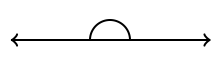
A straight angle looks like a straight line. Below is an example of a straight angle. A straight angle measures 180°
Acute angles
An acute angle is an angle whose degree measure is less than the right angle. Below is an example of an acute angle. An acute angle measures less than 90°

When we compare an acute angle to a right angle

Obtuse angles
An obtuse angle is an angle whose degree measure is greater than the right angle but less than the straight angle. Below is an example of an obtuse angle. An obtuse angle measures greater than 90° and less than 180°

When we compare an obtuse angle to a right angle, we can see that an obtuse angle is greater than 90°.

When we compare an obtuse angle to a straight angle, we can see that an obtuse angle is less than180°.

Reflex angles
A reflex angle is an angle whose degree measure is greater than the straight angle but less than the complete angle. Below is an example of a reflex angle. A reflex angle measures greater than 180° but less than 360°
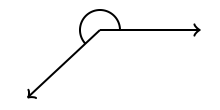
When we compare a reflex angle to a straight angle, we can see that a reflex angle is greater than 180°.

Complete angles
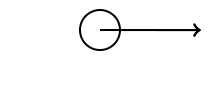
A complete angle is a 360° angle. A complete angle has both rays pointing the exact same direction. That is because we've turned a full circle from the first ray. Below is an example of a complete angle.
IV. Understanding Angle Measurement
There are two commonly used units of measurement of angles which are radians and degrees. In the case of practical geometry, we always measure the angle in degrees.
A degree is a unit of measure, denoted by the symbol °, used to indicate the measure an angle in a plane. An angle measuring 1°, read 1 degree, is equal to  of one complete revolution of the angle about its vertex. You can see from the diagram below that the counterclockwise rotation of the terminal side of an angle forms a circular path for the angle.
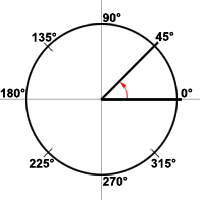
One full rotation is equivalent to 360°. One-quarter of a turn produces an angle that measures 90°, and one-half of a rotation creates an angle of 180°. While angles can have measures greater than what is shown, by doing multiple rotations, we will mostly only look at angle measures up to 360° in the study of Geometry.
Measure angles with a protractor
V. Measuring Angles
Measuring angles using a protractor
Reference
https://mathsquery.com/geometry/fundamentals/angle-and-types/
https://www.splashlearn.com/math-vocabulary/geometry/angle
https://www.mathplanet.com/education/geometry/points-lines-planes-and-angles/measure-and-classify-an-angle
https://www.khanacademy.org/math/cc-fourth-grade-math/plane-figures/imp-angle-introduction/a/angle-types-review
https://www.math.net/degree

No comments:
Post a Comment