Difference Between Mass and Weight
People often get confused between mass and weight and they end up using these two terms interchangeably. However, mass and weight are two different terms and it is important to understand the difference between them. The difference between mass and weight is shown in the table given below.
| Mass | Weight | |
|---|---|---|
| Definition | Mass is defined as the amount of matter in a substance | Weight is defined as the amount of force acting on the mass of an object because of acceleration due to gravity. |
| Denotation | Mass is represented by 'M' | Weight is represented by 'W' |
| Formula | •Mass is always constant for a body. •One way to calculate mass: Mass = volume × density | •Weight is the measure of the gravitational force acting on a mass. •Formula of weight: Weight = mass × acceleration due to gravity |
| Unit of Measurement | The SI unit of mass is 'kilogram' | The SI unit of weight is Newton (N). |
| Quantity Type | •Mass is a base quantity. •Mass only has magnitude and hence, it is a scalar quantity | •Weight is a derived quantity. •Weight has both magnitude and direction (toward the center of gravity) and hence, it is a vector quantity. |
| Measuring Instrument | Mass can be easily measured using any ordinary balance. For example, beam balance, lever balance, pan balance, etc. | Weight can be measured by a spring balance or by using the formula given above. |
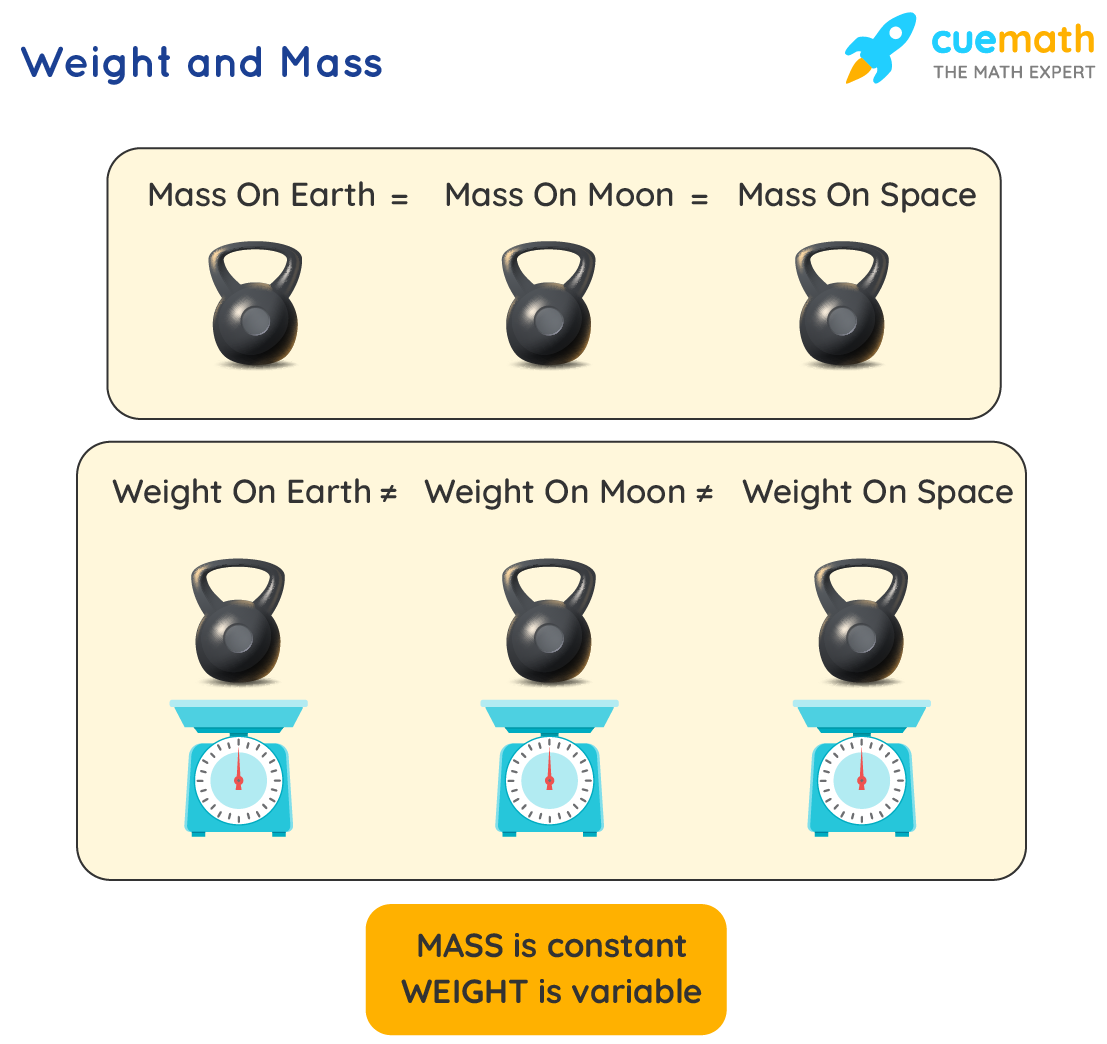
Did you know that we have different weights on the Earth, the Moon, and in space? However, our mass is the same everywhere.
Volume of a Cuboid
Suppose we have some rectangular sheets with length 'l' and width 'b'. If we stack them one on top of the other up to height 'h', we get a cuboid of dimensions l, b, h. This can be seen in the following figure which shows the length, width (breadth), and height of the cuboid thus formed.

To calculate the amount of space enclosed by this cuboid, we use the formula: Volume of a Cuboid = l × b × h

No comments:
Post a Comment