Tuesday, December 10, 2024

Plane Figures

I. Quadrilaterals Introduction
A quadrilateral is a polygon with four sides. The word ‘quadrilateral’ is derived from the Latin words ‘quadri,’ which means four, and ‘latus’, which means side.

A. Trapezoid 
A Trapezoid (Trapezium) is a type of quadrilateral where:
-one pair of opposite sides are parallel. 
B. Kite
A Kite is a type of quadrilateral that has:
-two pairs of consecutive equal sides 
-perpendicular diagonals


C. Parallelogram
A Parallelogram is a type of quadrilateral where:
-all opposite sides are parallel.
 
Types of parallelograms:
1. Rectangles
What makes a shape a rectangle?
-There are four right angles.

Here are some examples of rectangles:
A smaller horizontal rectangle.
A vertical rectangle.
A larger horizontal rectangle.
2. Rhombuses
What makes a shape a rhombus?
-All sides are the same length.
-There are four sides because it is a quadrilateral.

Here are some examples of rhombuses:
A shape with 4 equal sides and no right angles. The direction of each side is as follows, beginning at the top and continuing in a clockwise pattern: straight line to the right, straight line down and right, straight line to the left, straight line up and left.
A shape with 4 equal sides and no right angles. The direction of each side is as follows, beginning at the top and continuing in a clockwise pattern: straight line down and right, straight line down and left, straight line up and left, straight line up and right.
A shape with 4 equal sides and 4 right angles. The direction of each side is as follows, beginning at the top and continuing in a clockwise pattern: straight line to the right, straight line down, straight line to the left, straight line up.
3. Squares
What makes a shape a square?
-All sides are of equal length.
-There are four right angles.

Here are some examples of squares:
A larger shape with 4 equal sides and 4 right angles. The direction of each side is as follows, beginning at the top and continuing in a clockwise pattern: straight line to the right, straight line down, straight line to the left, straight line up.
A shape with 4 equal sides and 4 right angles. The direction of each side is as follows, beginning at the top and continuing in a clockwise pattern: straight line down and right, straight line down and left, straight line up and left, straight line up and right.
A smaller shape with 4 equal sides and 4 right angles. The direction of each side is as follows, beginning at the top and continuing in a clockwise pattern: straight line to the right, straight line down, straight line to the left, straight line up.
Note: A square is also is a type of rectangle and rhombus

II. Classifying Triangles
Angle Sum Property 
The angle sum property of a triangle states that the sum of the angles of a triangle is equal to 180º. A triangle has three sides and three angles, one at each vertex. Whether a triangle is an acute, obtuse, or a right triangle, the sum of its interior angles is always 180º.

Classifying triangles by their side lengths

Equilateral triangles

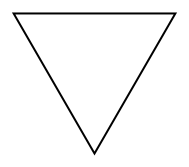
An equilateral triangle has three equal sides. Below are examples of equilateral triangles.
A triangle with side lengths of 10, 10, and 10 units.
A triangle with side lengths of 2, 2, and 2 units.

Isosceles triangles

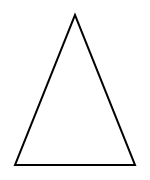
An isosceles  triangle has at least two equal sides. Below are examples of isosceles triangles.
A triangle with side lengths of 5, 5, and 4 units.
A triangle with side lengths of 5, 7, and 5 units.

Scalene triangles

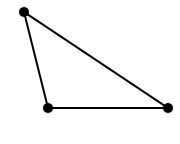
A scalene triangle has no equal sides. Below are examples of scalene triangles.
A triangle with side lengths of 6, 9, and 7 units.
A triangle with side lengths of 4, 7, and 5 units.

Classifying triangles by their angles

Acute triangles

An acute triangle has 3 angles that each measure less than 90°
. Below are examples of acute triangles.
A triangle with angle measures of 44 degrees, 68 degrees, and 68 degrees. The degree labels for all 3 angles are highlighted.
A triangle with angle measures of 60 degrees, 60 degrees, and 60 degrees. The degree labels for all 3 angles are highlighted.

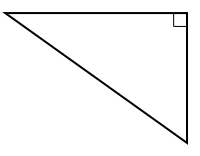
Right triangles

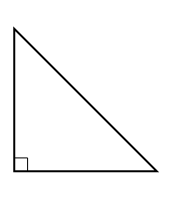
A right triangle has 1 angle that measures 90° and 2 acute angles. Below are examples of right triangles.
A triangle with angle measures of 90 degrees, 45 degrees, and 45 degrees. The 90 degrees angle label is highlighted.
A triangle with angle measures of 90 degrees, 54 degrees, and 36 degrees. The 90 degrees angle label is highlighted.

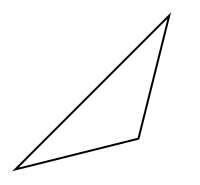
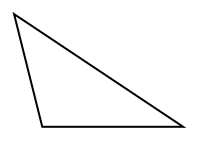
Obtuse triangles

An obtuse triangle has one angle that measures more than 90° and 2 acute angles. Below are examples of obtuse triangles.
A triangle with angle measures of 118 degrees, 31 degrees, and 31 degrees. The 118 degrees angle label is highlighted.
A triangle with angle measures of 104 degrees, 42 degrees, and 34 degrees. The 104 degrees angle label is highlighted.

III. Parallel and Perpendicular
Parallel lines are two or more lines that lie in the same plane and never intersect each other. They are equidistant from each other and have the same slope

Perpendicular lines are two distinct lines that intersect each other at 90°.


Classifying Geometric Shapes


https://www.splashlearn.com/math-vocabulary/geometry/quadrilateral

https://www.cuemath.com/geometry/quadrilaterals/

https://www.cuemath.com/geometry/properties-of-kite/

https://www.khanacademy.org/math/basic-geo/basic-geometry-shapes/x7fa91416:quadrilaterals-introduction/a/identify-quadrilaterals

https://www.cuemath.com/geometry/angle-sum-property/