I. Present Value Formula
FV=PVx(1+i)ⁿ
We can rearrange this future value formula into the present value formula
PV=FV/(1+i)ⁿ
Where:
PV = Present value amount.
FV = Future value amount
n = Number of time periods that interest will be added and compounded over the life of the deposit, cost, etc.
i = Periodic interest rate aka discount rate (annual rate adjusted for number of compounding periods per year. For example, if interest is to be compounded monthly, then a rate of 12% per year will be restated to be 1% per month.)
Example 1
You buy a refrigerator for $800 but you don’t have to make the payment until next year (that is, one year later). The opportunity cost of money is 3%. Opportunity cost represents what you could earn with the money – in this case, the return on your best investment opportunity. What price are you paying for the refrigerator in present dollars? PV=$800/(1+0.03)¹
PV=$800/1.03¹
PV=$800/1.03
PV=$776.70
Example 2
Lets say you can defer payment on the refrigerator for an additional year.
PV=$800/(1+0.03)²
PV=$800/1.03²
PV=$800/1.0609
PV=$754.08
Multiple Compounding Periods In A Year
As we discussed in the compound interest/future value of a single amount section, make sure your i and n amounts are correct.
Example 3
What is the present value of receiving a single amount of $10,000 at the end of five years, if the time value of money is 6% per year, compounded semiannually?Here n = 10, because there are 10 six-month (or semiannual) periods in five-years time (5 years x 2 semiannual payments per year). Because the compounding occurs semiannually, the rate for discounting is i = 3% per six-month period (the annual rate of 6% divided by the two semiannual periods in each year).
PV=$10,000/(1+0.03)¹⁰
PV=$10,000/(1.03)¹⁰
PV=$10,000/1.3439164
PV=$7,440.94
Here's another version of the same present value formula with slightly different variables. This one is designed to be fool proof since it figures the periodic interest rate for you (r/n) as well as the correct exponent (nt).
Formula for Present Value
The present value formula is:

| where | P = present value |
| A = desired future amount | |
| r = nominal interest rate (as a decimal fraction) | |
| n = number of times interest is calculated in one year | |
| t = times (in years) |
EXAMPLE 4
A house painting company is planning to expand its operations in three years time. It will require $24,000 in order to expand. How much must it invest now, at 4.6% interest compounded annually?
Solution
| P = ? A = $24000 r = 4.6% = 0.046 n = 1 | | |
| t = 3 years | 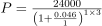 | Replace the variables with their values |
 | Add  | |
 | Raise  | |
 |
The present value is $20,970.86 so the company must invest that amount now to have $24,000 in three years.
II. Discount Factor
A discount factor is a decimal number multiplied by a cash flow value to discount it back to its present value. The discount factor can be derived from the net present value formula above. 1. Net Present Value Formula
PV = FV/(1 + r)ⁿ
2. Make FV = 1, and change PV to DF (Discount Factor)
DF = 1/(1 + r)ⁿ
Example:
We will use example 2 from above. The discount rate for that problem is 3%.
DF = 1/(1 + 0.03)²
DF = 0.9426
Now multiply the future value of $800 by the discount rate.
$800 x 0.9426 = $754.08
This matches the answer from example 2.
https://efficientminds.com/wp-content/uploads/2012/08/web_chapter_28_tvm.pdf
https://www.accountingcoach.com/present-value-of-a-single-amount/explanation/3
https://opentextbc.ca/businesstechnicalmath/chapter/9-2-compound-interest-2/
https://www.wallstreetprep.com/knowledge/discount-factor/

No comments:
Post a Comment