Wednesday, November 27, 2024

Money

A currency is a system of money in general use in a particular country and includes both paper bills and coins.   

Decimalization of US Money
Dollars and cents are the units of money used in the United States. 

Dollars are the whole number part of the decimal. For example, in $3.25, the "3" represents 3 whole dollars.

Cents are the fractional part of the decimal. They represent parts of a dollar, with 1 dollar equal to 100 cents.

The decimal point separates the dollars from the cents: The first number after the decimal is the tenths place, representing dimes (10 cents each). The second number after the decimal is the hundredths place, representing pennies (1 cent each).

For example, $3.25 means 3 dollars, 2 dimes (20 cents), and 5 pennies (5 cents). Dollars and cents are a real-world example of how decimals and place value work!

Writing Dollars and Cents

In the U.S., money values are written using dollars and cents, with a dollar sign ($) to show it’s money. Here’s how it works:

  1. If it’s only dollars:
    Write the number of dollars followed by the dollar sign, like this:

    • $5 means 5 dollars.
    • $20 means 20 dollars.
  2. If it’s dollars and cents:
    Write the dollar amount, then a decimal point (.), and then the number of cents (always two digits):

    • $1.25 means 1 dollar and 25 cents.
    • $3.50 means 3 dollars and 50 cents.
  3. If it’s only cents:
    Use the ¢ symbol to show just the cents:

    • 50¢ means 50 cents.
    • 25¢ means 25 cents.

You can also write cents as part of a dollar amount. In that case, you use a dollar sign ($) and a decimal point:

  • $0.50 means 50 cents (half of a dollar).
  • $0.10 means 10 cents.
  • $0.01 means 1 cent.

US Coins in circulation as of 2024.
Coins
The penny, nickel, dime, and quarter are the circulating coins that we use today and have been the primary coins used for many years.


There have been many other coins produced in the past such as various half dollars and dollar coins which are still legal tender. 

Bills (Bank Notes)
American paper currency comes in seven denominations: $1, $2, $5, $10, $20, $50, and $100. Tthe $2 bill is printed in very small quantities and almost never used. 

The United States no longer issues bills in larger denominations, such as $500, $1,000, $5,000, and $10,000 bills but they are still legal tender and may still be in circulation.


Practice:


Reference

https://en.wikipedia.org/wiki/Currency

https://en.wikipedia.org/wiki/Banknotes_of_the_United_States_dollar

https://www.splashlearn.com/math-vocabulary/money/cent

https://flexbooks.ck12.org/cbook/ck-12-middle-school-math-concepts-grade-6/section/3.4/primary/lesson/combinations-of-decimal-money-amounts-msm6/

https://www.npr.org/sections/money/2012/08/06/158197529/why-are-there-100-cents-in-a-dollar-ask-thomas-jefferson

chatgpt

Tuesday, November 26, 2024

Division: Partial Quotients Method

The partial quotients method (also called stacking or chunking method) is an elementary approach for solving simple division questions by repeated subtraction. It is also known as the hangman method with the addition of a line separating the divisor, dividend, and partial quotients.

To calculate the whole number quotient of dividing a large number by a small number, the student repeatedly takes away "chunks" of the large number, where each "chunk" is an easy multiple (for example 100×, 10×, 5× 2×, etc.) of the small number, until the large number has been reduced to zero – or the remainder is less than the small number itself.


Understanding Partial Quotients as a Division Strategy
The division operation is defined as the process of repeated subtraction. It is exactly the opposite of multiplication. In the standard form of division, the divisor is used to determine how many times it can be subtracted from the dividend.

Example:
20 ÷ 5

20 - 5 = 15
15 - 5 = 10
10 - 5 = 5
5 - 5 = 0

5 is subtracted 4 times to get the remainder of 0.

so 

20 ÷ 5 = 4

In the partial quotient division, we break the dividend into smaller parts by subtracting multiples of the divisor until the remainder is 0 or less than the divisor. The multipliers (numbers used to multiply the divisor to find these multiples) are the partial quotients, which are then summed to find the final quotient.

Steps with Example


https://mrsrenz.com/division-strategies-made-easier-partial-quotients-method-and-more/

https://www.splashlearn.com/math-vocabulary/division/partial-quotient

https://en.wikipedia.org/wiki/Chunking_(division)

Thursday, November 21, 2024

Future Value of an Ordinary (Simple) Annuity

Consider the ordinary annuity diagrammed previously, where you deposit $100 at the end of each year for 3 years and earn 5% per year.

To see how the annuity process works, consider the following table. 

Since this is an ordinary annuity the payments are made at the end of the month. The first payment of $100 is made at the end of the year and therefore no interest is earned for that year. At the beginning of year 2 there is $100 in the account. Interest for year 2 is $100 x 5% = $5. At the end of year 2 another $100 is deposited so the balance at the end of year 2 is $100 + $5 + $100 = $205. At the beginning of year 3 there is $205 in the account. Interest for year 3 is $205 x 5% = $10.25. At the end of year 3 another $100 is deposited so the total balance at the end is $205 + $10.25 + $100 = $315.25.

Here's the same example presented as a timeline


As you can see from the time line diagram, with the step-by-step approach we apply the following equation, with n = 3 and i = 5%: 

FVA = PMT(1 + i)ⁿ⁻¹ + PMT(1 + i)ⁿ⁻² + PMT(1 + i)ⁿ⁻³
FVA = $100(1.05)³⁻¹ + $100(1.05)³⁻² + $100(1.05)³⁻³
FVA = $100(1.05)² + $100(1.05)¹ + $100(1.05)⁰
FVA = $100(1.1025) + $100(1.05) + $100(1)
FVA = $110.25 + $105.00 + $100
FVA = $315.25


From the above process we derive the future value formula of:

FVA = PMT[(1+i)ⁿ -1/i]

Here's a clearer depiction


Where FVA (or FV) = Future Value of Annuity
PMT = Payment
i = Interest rate (adjust if compounded more than once a year)
n = number of periods (adjust if compounded more than once a year)


Going back to our earlier example, using the formula would look like this:

FVA = $100[(1+0.05)³ -1/0.05]
FVA = $100[(1.05)³ -1/0.05]
FVA = $100[1.157625 - 1/0.05]
FVA = $100[0.157625/0.05]
FVA = $100[3.1525]
FVA = $315.25

Adjusting for Multiple Compounding Periods
If the 


https://efficientminds.com/wp-content/uploads/2012/08/web_chapter_28_tvm.pdf

http://www.csun.edu/~jpd45767/303/4%20-%20The%20Time%20Value%20of%20Money.pdf

https://www.cuemath.com/ordinary-annuity-formula/

https://financetrain.com/future-value-and-present-value-of-ordinary-annuity

https://opentextbc.ca/businesstechnicalmath/chapter/9-4-annuities/

Tuesday, November 19, 2024

Deriving the Future Value Formula

I had a difficult time understanding how the future value formula actually compounded the interest. It wasn't till I used the numbers in expanded form did I understand what was happening. 

1. First Attempt 
Example 
What is the future value of 1$ compounded annually at a interest rate of 5% in two years.

FV=PV(1.00+i)ⁿ
FV=1$(1.00+.05)²
FV=1$(1.05)²
FV=$1(1.1025)
FV=$1.1025 ≅ $1.10

But what is happening? I wasn't understanding how the interest was being calculated on the interest. Here's how it works

1.05² = 1.05 x 1.05 
= (1 + .05) x (1 + .05)

Distribute:
1 x 1 = 1
1 x .05 = .05 (these two equal the first period interest and principal calculation)
.05 x 1 = .05
.05 x .05 = .0025 (this is the interest on the interest part of the calculation)


2. Second Attempt
Here's a much better way of understanding the formula.

Example
What is the future value of $4000 compounded semiannually at a interest rate of 12% in one year.

Periodic interest rate = 12% / 2 = 6%

At the end of the first six months (one compounding period) of the loan, the value of the loan is:

FV = PV + i x PV
      =  $4000 + 0.06 x $4000
      = $4240

In the above calculation FV =  PV + i x PV can be rewritten as FV = PV(1 + i)

How do find the value after the second compounding period?

FV = PV(1 + i) x (1 + i)

Working through this step by step you can see why this works

FV = $4000(1 + 0.06) x (1 + 0.06)
      = ($4000 + 240) x (1 + 0.06)
      = $4240 x (1 + 0.06)   
      = $4240 + $254.40
      = $4494.40

You can see on the third step of the calculation the value of the loan at the end of the first compounding period of $4240. The fourth line gives us the interest calculated for the second compounding period. Finally we add them together to get the future value at the end of the year. 

The equation above of FV = PV (1 + i) x (1 + i) can be simplified to FV = PV (1 + i)²

And now we have derived are compound interest formula.

Wednesday, November 13, 2024

Annuities

Thus far, we have dealt with single payments, or “lump sums.” However, many assets provide a series of cash inflows over time, and many obligations like auto loans, student loans, and mortgages require a series of payments. 

If the payments are equal and are made at fixed intervals, then the series is an annuity.

There are two basic types of annuities. 
1. Ordinary annuities are annuities where payment is due at the end of each payment period.
2. Annuity due is an annuity where the payment is due at the beginning of each payment period. 

Here are the time lines for a $100, 3-year, 5%, ordinary annuity and for the same annuity on an annuity due basis.


The two types of annuities can also be categorized as either simple or general. 

1. Simple annuity are annuities where the payment and compounding frequencies are equal. 
2. General annuity are annuities where the payment and compounding frequencies are not equal. 


https://ecampusontario.pressbooks.pub/businessmathtextbook/chapter/11-1-fundamentals-of-annuities/#:~:text=Simple%20Annuity%20Due&text=Payments%20are%20made%20at%20the%20beginning%20of%20the%20payment%20intervals,the%20end%20of%20the%20annuity.
https://ecampusontario.pressbooks.pub/finmath1175/chapter/2-2-future-value-of-annuities/

https://efficientminds.com/wp-content/uploads/2012/08/web_chapter_28_tvm.pdf

http://www.csun.edu/~jpd45767/303/4%20-%20The%20Time%20Value%20of%20Money.pdf

https://www.cuemath.com/ordinary-annuity-formula/

https://financetrain.com/future-value-and-present-value-of-ordinary-annuity

https://opentextbc.ca/businesstechnicalmath/chapter/9-4-annuities/

Tuesday, November 12, 2024

Present Value of a Single Amount

I. Present Value Formula

The present value of a single future payment is the amount that the payment is worth today. Finding the present value is called discounting, which is the reverse of compounding. 

Whenever we need to find the present value of a future amount, we can use the future value formula, just rearranged. Take our future value formula,

FV=PVx(1+i)ⁿ

We can rearrange this future value formula into the present value formula

PV=FV/(1+i)ⁿ

Where:
PV = Present value amount. 
FV = Future value amount
n = Number of time periods that interest will be added and compounded over the life of the deposit, cost, etc. 
i = Periodic interest rate aka discount rate (annual rate adjusted for number of compounding periods per year. For example, if interest is to be compounded monthly, then a rate of 12% per year will be restated to be 1% per month.)


Example 1
You buy a refrigerator for $800 but you don’t have to make the payment until next year (that is, one year later). The opportunity cost of money is 3%. Opportunity cost represents what you could earn with the money – in this case, the return on your best investment opportunity. What price are you paying for the refrigerator in present dollars?

PV=$800/(1+0.03)¹

PV=$800/1.03¹

PV=$800/1.03

PV=$776.70

Example 2
Lets say you can defer payment on the refrigerator for an additional year.

PV=$800/(1+0.03)²

PV=$800/1.03²

PV=$800/1.0609

PV=$754.08


Multiple Compounding Periods In A Year
As we discussed in the compound interest/future value of a single amount section, make sure your i and n amounts are correct. 

Example 3
What is the present value of receiving a single amount of $10,000 at the end of five years, if the time value of money is 6% per year, compounded semiannually?

Here n = 10, because there are 10 six-month (or semiannual) periods in five-years time (5 years x 2 semiannual payments per year). Because the compounding occurs semiannually, the rate for discounting is i = 3% per six-month period (the annual rate of 6% divided by the two semiannual periods in each year).

PV=$10,000/(1+0.03)¹⁰

PV=$10,000/(1.03)¹⁰

PV=$10,000/1.3439164

PV=$7,440.94


Here's another version of the same present value formula with slightly different variables. This one is designed to be fool proof since it figures the periodic interest rate for you (r/n) as well as the correct exponent (nt). 

Formula for Present Value

The present value formula is:

P = \frac{A}{\left( 1 + \frac{r}{n} \right)^{nt}}

whereP = present value
A = desired future amount
r = nominal interest rate (as a decimal fraction)
n = number of times interest is calculated in one year
t = times (in years)

EXAMPLE 4

A house painting company is planning to expand its operations in three years time. It will require $24,000 in order to expand. How much must it invest now, at 4.6% interest compounded annually?

Solution

P = ?

A = $24000

r = 4.6% = 0.046

n = 1

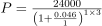
P = \frac{A}{\left( 1 + \frac{r}{n} \right)^{nt}}
t = 3 yearsP = \frac{24000}{\left( 1 + \frac{0.046}{1} \right)^{1 \times 3}}Replace the variables with their values
P = \frac{24000}{\left( 1.046\right)^{3}}Add 1+0.046= 1.046
P = \frac{24000}{1.144445}Raise \left( 1.046\right)^{3} = 1.144445
P = 20970.86

The present value is $20,970.86 so the company must invest that amount now to have $24,000 in three years.


II. Discount Factor
A discount factor is a decimal number multiplied by a cash flow value to discount it back to its present value. The discount factor can be derived from the net present value formula above. 

1. Net Present Value Formula

PV = FV/(1 + r)ⁿ

2. Make FV = 1, and change PV to DF (Discount Factor)

DF = 1/(1 + r)ⁿ

Example: 
We will use example 2 from above. The discount rate for that problem is 3%.

DF = 1/(1 + 0.03)²

DF = 0.9426

Now multiply the future value of $800 by the discount rate.

$800 x 0.9426 = $754.08

This matches the answer from example 2.


https://efficientminds.com/wp-content/uploads/2012/08/web_chapter_28_tvm.pdf
https://www.accountingcoach.com/present-value-of-a-single-amount/explanation/3
https://opentextbc.ca/businesstechnicalmath/chapter/9-2-compound-interest-2/
https://www.wallstreetprep.com/knowledge/discount-factor/


Wednesday, November 6, 2024

Interest Rates Explained

I. Based On Calculation Method
1. Simple Interest
Interest is calculated only on the original principal.

2. Compound Interest
Interest is calculated on both the principal and previously accrued interest.

See other sections for detailed explanations.

II. Based On Timing & Adjustments (Common Rates) 
1. Nominal interest rate 
The stated interest rate. It is the rate usually stated in advertisements. The stated rate of interest does not take into account compounding. 

2. Annual Percentage Rate (APR)
The APR is the annual rate charged for borrowing or earned through an investment, including fees and other costs, but not accounting for compounding. It is essentially the nominal rate plus the effect of upfront fees (like loan origination, points, some closing costs), spread over the life of the loan.

3. Effective interest rate 
The true interest being charged or earned which accounts for compounding. This is also known as the effective annual interest rate. When interest compounds—interest accrues on the previously earned interest—the total interest amount can increase. And the rate of compounding—such as daily, monthly, quarterly or annually—affects how quickly the interest accrues.

Example 1 (annual compounding)
Suppose you open a 12-month certificate of deposit (CD) with a 5% interest rate and deposit $10,000. If the interest compounds annually, you’ll have $10,500 at the end of the year—the 5% nominal interest rate is the same as the effective annual interest rate.

Example 2 (monthly compounding)
Consider if the interest compounds monthly. You earn $41.67 at the end of the first month, and the 5% interest rate applies to your new $10,041.67 balance for month two. It keeps compounding, and by the end of the year, you will have $10,511.62. The nominal rate is still 5%. But your effective annual interest rate is 5.116% because that reflects how much interest you actually earned over the year.

Effective annual interest rate formula
The effective rate or effective annual is used to compare the interest rates between loans with different compounding periods. The formula for calculating the effective annual interest rate is:

r = (1 + i/n)ⁿ - 1

r = effective annual interest rate
i = nominal interest rate written as a decimal
n = compounding periods per year

Example 1
What is the effective annual interest rate for 6% compounded monthly?

r = (1 + 0.06/12)¹² - 1

r = (1 + 0.005)¹² - 1

r = (1.005)¹² - 1

r = 1.0617 - 1

r = 0.0617 = 6.17%


To drive the lesson home, here is a future value calculation for $1000 invested for one year at an annual interest rate of 6% compounded monthly


Notice that the interest for any period divided by the beginning balance for that period is the nominal interest rate of 6% but if you take the total interest for the year of $61.68 and divide it by the beginning investment of $1000 you get .06168 rounded to three decimal places equals .0617 = 6.17%. The same as the answer above. 

4. Real Interest Rate
The real interest rate is the rate of interest an investor, saver or lender receives (or expects to receive) after allowing for inflation. It can be described more formally by the Fisher equation, which states that the real interest rate is approximately the nominal interest rate minus the inflation rate.

The most common and straightforward way to calculate the real interest rate is using the Fisher equation. The approximate formula is:

For a more precise calculation, especially with higher inflation rates, the exact formula is:


III. Rate Behavior
1. Fixed Interest Rate
Stays constant for the loan/investment term.

2. Variable (Floating) Interest Rate
Fluctuates over time based on a benchmark (e.g., SOFR, Prime).

3. Adjustable Rate
Hybrid: Often fixed for a period, then becomes variable


IV. By Benchmark or Source

1. Central Bank Rates
A. Federal Funds Rate (U.S.)

B. Discount Rate 
rate charged by the central bank to commercial banks

2. Interbank Rates
A. Secured Overnight Financing Rate (SOFR)

B. EURIBOR, SONIA 
(used internationally)

3. Prime Rate
Set by banks as a base rate for best customers; often used as a benchmark for loans.


V. Economic Function
1. Discount Rate
Used to determine the present value of future cash flows (time value of money).