The Mycenaeans also kept palace records in a syllabic script, known as Linear B. Related to the Cretan Linear A script, Linear B, however, has been deciphered, and identified as Greek.
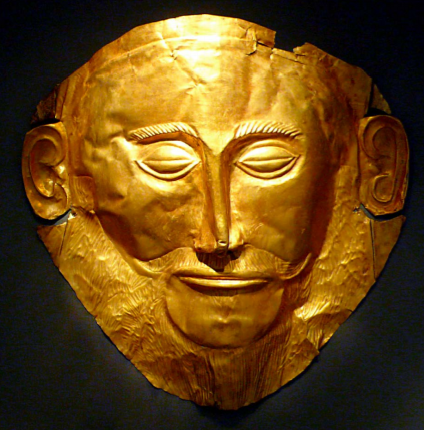.png?revision=1) Figure 5.8.35.8.3: Mask of Agamemnon, Mycenae Author: User “Xuan Che” Source: Wikimedia Commons License: CC BY 2.0
Figure 5.8.35.8.3: Mask of Agamemnon, Mycenae Author: User “Xuan Che” Source: Wikimedia Commons License: CC BY 2.0Archaeological evidence also shows that sometime in the 1,200s BCE, the Mycenaean palaces suffered a series of attacks and were gradually abandoned over the next century. The period that begins around 1,000 BCE is known as the “Dark Ages” because of the notable decline, in contrast with the preceding period. The Mycenaean Linear B script disappears, and archaeological evidence shows a poorer Greece with a decline in material wealth and life expectancy. Some contact, however, must have remained with the rest of the Mediterranean, as shown by the emergence of the Greek alphabet, adapted from the Phoenician writing system towards the end of the Dark Ages or early in the Archaic Period.(1)
(1) Book: World History - Cultures, States, and Societies to 1500 (Berger et al.)

No comments:
Post a Comment