King Minos & The Minotaur Zeus was enamoured of Europa and decided to seduce or rape her, the two being near-equivalent in Greek myth. He transformed himself into a tame white bull and mixed in with her father's herds. While Europa and her helpers were gathering flowers, she saw the bull, caressed his flanks, and eventually got onto his back. Zeus took that opportunity and ran to the sea and swam, with her on his back, to the island of
Crete. He then revealed his true identity, and Europa became the first queen of Crete. Zeus gave her a necklace made by
Hephaestus and three additional gifts: the bronze
automaton guard
Talos, the hound
Laelaps who never failed to catch his quarry, and a
javelin that never missed. Zeus later re-created the shape of the white bull in the stars, which is now known as the constellation
Taurus.(1)
During her time with Zeus, Europa gave birth to Minos, Rhadamanthus and Sarpedon. Zeus eventually returns to Olympus and Europa marries king Asterion. Asterion and Europa had no other children, so the king raised Zeus’s sons as his own. When he died, he left his kingdom to his wife’s eldest child, Minos. Minos and his brothers argued over the succession, however. After a brief conflict, Minos was victorious and expelled his brothers from his kingdom.(2)
Because of his disputed claim to the throne, however, Minos asked for a sign of the gods’ favor. He prayed to
Poseidon to send a white bull to show that Minos had his approval. Poseidon sent Minos the bull, with the understanding that bull would be sacrificed to the god. Deciding that Poseidon's bull was too fine of a specimen to kill, Minos sent the bull to his herds and substituted another, inferior bull for sacrifice.(2)(3) Poseidon was furious that a mortal king would show such disrespect and break a vow to a god. Poseidon punished Minos harshly for the offense. First, he turned the Cretan Bull from docile creature to a raving beast. The bull went completely wild, rampaging around the island and leaving destruction everywhere it went. The sea god then went a step farther. He asked
Eros to make Pasiphae, Minos’s wife, to fall in love with the now-wild bull. With a shot from Eros’s bow, the queen fell desperately in love with the animal. She was wholly consumed by this unnatural attraction. Pasiphae commanded Daedalus, the great inventor in service to Minos, to construct a wooden cow. Hiding inside, she was able to lure the Cretan Bull close to herself. The result of Pasiphae’s curse was the birth of the
Minotaur. The half-bull, half-human monster was a voracious cannibal who soon began to threaten the people of the capital city, Knossos. To contain the beast, Minos had Daedalus build the Labyrinth. The maze-like underground prison was designed to make sure that the Minotaur could not find its way out.
The creature still terrorized the people of Knossos, however. When it grew hungry it roared and bellowed with such fury that it shook the ground beneath the city. Minos found a solution in the recently conquered city of Athens. He demanded that young men and women be sent to Crete, fourteen at a time, as sacrifices to the terrible monster.(2)
Theseus
Icarus
Initially though, King Minos was more angry about the help given by Daedalus than he was about the intrigue of his own daughter Ariadne. Minos though did not want to lose the services of the master craftsman, and so rather than being executed, Daedalus and Icarus were instead locked away in a tall tower (or in other sources father and son were locked within the Labyrinth).
No prison would keep an inventor like Daedalus locked up, but Daedalus realised that he and Icarus need not to just escape their prison but they needed to leave Crete as well. Sailing away from Crete would appear to be the most likely solution, but the Cretan navy of King Minos comprised the quickest vessels of the age.(4)
“He [Minos] may thwart our escape by land or sea but the sky is surely open to us: we will go that way: Minos rules everything but he does not rule the heavens’.”
Ovid, VIII.183Daedalus decided that he and Icarus must fly away.
Of course manned flight had never been undertaken before, and so Daedalus had to invent a method of flying. The plan was simplicity itself, for he had Icarus gather together all of the shed feathers that were to be found in their prison, then with wax, Daedalus glued the amassed feathers to wooden frames, and soon two sets of wings had been manufactured.
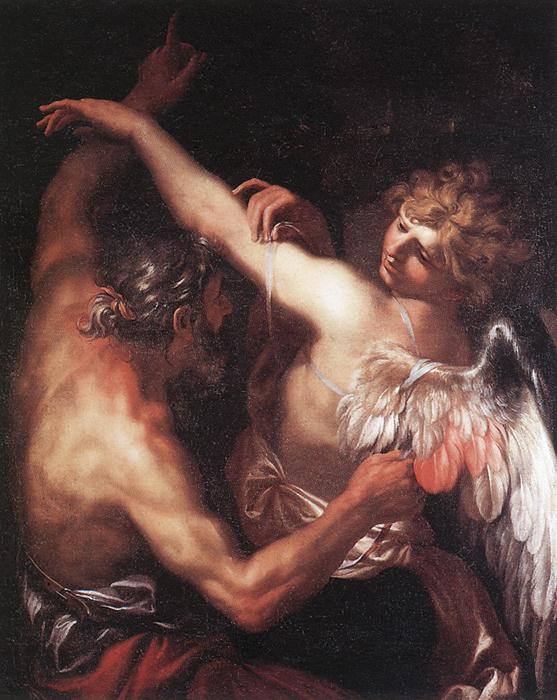
Daedelus and Icarus - Domenico Piola (1627-1703) - PD-art-100
Daedalus realized that the wings he had manufactured had many weaknesses, and so pre-warned Icarus about the dangers of flying too high, or indeed flying too low. Too high would see the wax being used as glue melt, whilst too low, would see the seawater impregnating the feathers and wood, making the wings too heavy to fly.(4)
“Let me warn you, Icarus, to take the middle way, in case the moisture weighs down your wings, if you fly too low, or if you go too high, the sun scorches them. Travel between the extremes. And I order you not to aim towards Bootes, the Herdsman, or Helice, the Great Bear, or towards the drawn sword of Orion: take the course I show you!”
Ovid, VIII.183-235The day arrived when Icarus and Daedalus would escape from Crete, and the pair leapt from a ledge together, flapping the manufactured wings as they did so; thus man’s first flight was undertaken just as the birds did.
The escape was successful, and undetected, and soon through a mixture of wing flapping and gliding, Daedalus and Icarus had left Crete far behind. Many miles were soon put between King Minos and the escaping pair, but as Icarus and his father approached the island of Samos, disaster struck.
Icarus had become over confident, and ignoring the warnings previously given by Daedalus, he started to fly higher and higher. The worst fears of Daedalus were soon realised for as Icarus flew closer to the sun, the wax began to melt, and the feathers soon became detached from the wooden frame. In a very short time, all that Icarus was left clinging onto were the wooden frames, and so Icarus plunged seawards, dying as he hit the water.
The area of water where Icarus hit would become known as the Icarian Sea, whilst the previously unnamed island where the body of Icarus washed up was subsequently called Icaria.
Daedalus of course had to watch his son fall to his death with no way of intervening, the grieving Daedalus would have to fly on alone to safety. Some sources though claim that the Greek hero Heracles had witnessed the death of Icarus, and recognizing the boy as the son of Daedalus, Heracles was said to have performed the necessary funeral rites which Icarus’ father had been unable to do.(4)
(1) Wikipedia: Europa (consort of Zeus)
(2) https://mythologysource.com/why-did-poseidon-curse-the-wife-of-king-minos/
(3) https://en.wikipedia.org/wiki/Cretan_Bull
(4) https://www.greeklegendsandmyths.com/icarus.html
https://www.thecollector.com/daedalus-and-icarus/
https://jgpeiretti.medium.com/the-myth-of-icarus-and-daedalus-9d3e51ada9be
Chatgpt: Sources
1. Homer
2. Hesiod
3. Apollodorus
-
Works: Bibliotheca (Library) (circa 1st or 2nd century CE)
-
Connection: Offers one of the most detailed versions of the Minotaur myth, including the labyrinth and Theseus's heroics.
4. Ovid
-
Works: Metamorphoses (circa 8 CE)
-
Connection: Retells parts of the myth, emphasizing Daedalus and Icarus, with background on the labyrinth and the Minotaur.
5. Plutarch
-
Works: Life of Theseus (circa 1st century CE)
-
Connection: Provides a biography of Theseus, including his slaying of the Minotaur and abandonment of Ariadne.
6. Euripides
-
Works: Lost plays (e.g., Cretans and Theseus) (circa 5th century BCE)
-
Connection: Survives in fragments, likely dramatized Theseus's battle with the Minotaur and his relationship with Ariadne.
7. Pausanias
-
Works: Description of Greece (circa 2nd century CE)
-
Connection: Geographical and historical context for myths, mentioning the labyrinth and Athenian connections.
8. Diodorus Siculus
-
Works: Bibliotheca Historica (circa 1st century BCE)
-
Connection: Retells the Minotaur myth, with emphasis on the roles of Minos and Theseus.
9. Hyginus
-
Works: Fabulae (circa 1st century CE)
-
Connection: Summarizes the Minotaur myth, highlighting Ariadne’s help and Theseus's escape.
10. Virgil
Visual and Archaeological Sources
-
Minoan Frescoes and Artifacts: (circa 1700–1400 BCE)
-
Connection: Visual representations of bulls and labyrinth motifs, notably from Knossos, provide a cultural basis for the myth.
These dates help situate the Minotaur myth within the broader timeline of Greek literature, Roman adaptations, and Minoan cultural influence.
https://www.theoi.com/Text/Apollodorus3.html#1

.png?revision=1)
.png?revision=1&size=bestfit&width=808&height=485)