Friday, October 25, 2024

Compound Interest/Future Value of a Single Amount

The biggest difference between simple interest and compound interest is that simple interest is computed on the original principal only. Compound interest, on the other hand, multiplies the interest rate by the original principal plus any interest that has accumulated during the time period of the transaction. So compound interest is earning interest on previously earned interest.

But how does compound interest compare to simple interest? The critical difference is the placement of interest into the account. Under simple interest, you convert the interest to principal at the end of the transaction’s time frame.

I. Concept

Figure 1 illustrates the process of compounding or earning interest on interest. Consider an investment of $100 that earns 10% year with interest being compounded semiannually.  With semiannual compounding the interest on the investment will be calculated twice during the year.
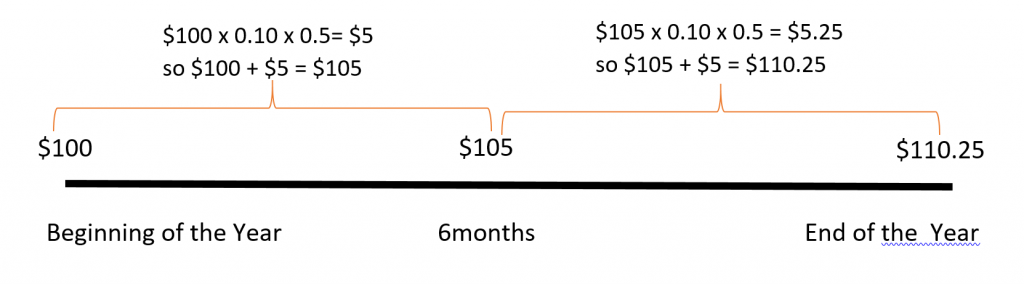
Fig. 1

Using the simple interest formula I = Prt,  at the end of six months (half a year) interest will be calculated as follows:

I = $100 x 10% x 1/2 year = $5.

Adding this $5 to the principal of $100 you will have $105 at the end of the first six months. At the end of the year interest will be calculated again on the $105:

I = $105 x 10% x 1/2 year = $5.25.

Adding this $5.25 to $105 you will have $110.25 at the end of the year. In this case you would be earning interest not only on the original principal of $100, but also on the previously earned interest of $5. When interest is earned on interest, we say the interest is compounded. The total amount of principal and accumulated interest at the end of a loan or investment is called the compound amount. 


Consider a $100 investment that earns 10%/year compounded annually. The table in Figure 2 shows how the value of the $100 investment will grow over a 6-year period.

YearAmount at the beginning of the yearEarned InterestYear End Total
1$100$10$110
2$110$11$121
3$121$12.10$133.10
4$133.10$13.31$146.41
5$146.41$14.64$161.05
6$161.05$16.11$177.16

Fig. 2

At the beginning of Year 1, $100 is invested, so the interest earned in the first year will be:

I = Prt = $100 × 0.10 × 1  = $10. This is added to the original $100 to result in $110 at the end of Year 1.

At the beginning of Year 2 the process will repeat but the principal P is now $110.

I = Prt = $110 × 0.10 ×1 = $11 in interest so at the end of Year 2 there will be:

$110 + $11 = $121 in the account.

Notice that the compound amount at the end of the six year period is $177.16.  The investment has earned an accumulated $77.16 in interest. If the investment had earned simple interest as opposed to compound interest it would have only earned:

I = Prt = 100 × 0.10 × 6 =  $60 in interest.


II. Compound Interest Formula
The above method of calculating the compound amount is very time consuming. Fortunately, there is a mathematical formula that we can use when working with compound interest.


Compound Interest Formula

The compound interest formula is:

A = P \left ( 1 + \frac{r}{n}\right )^{nt}where,A = total compound amount(includes principal and interest)
P = principal
r = annual interest rate
n = number of times in one year that interest is calculated
t = time (in years)

Since A includes both the principal and interest, to find the interest amount I calculate:
I = A - P


EXAMPLE 1

Find the compound amount and the interest earned on $100 compounded annually at 10% for 6 years.

Solution

P = $100

r = 10% = 0.1

n = 1 (since the interest is calculated once a year)

t = 6 years

A = P \left ( 1 + \frac{r}{n}\right )^{nt}

A = 100 \left ( 1 + \frac{0.1}{1}\right )^{1 \times 6}

Replace the variables with their values
A = 100 \left ( 1 + 0.1\right )^{6}\frac{0.1}{1} = 0.1 and 1 \times 6 = 6
A = 100 \left ( 1.1 \right )^{6}Raise \left( 1.1 \right)^{6} = 177.1561
A = 100 \left ( 1.771 561 \right ) = 177.1561

The interest earned is A - P = \$ 177.16 - \$100 = $77.16

The compound amount is $177.16

Compounding Periods

Interest can be compounded using a variety of compounding periods.   The compounding period is the span of time between when interest is calculated and when it will be calculated again. If there is one month between every interest calculation then the compounding period is monthly.  With monthly compounding there will be 12 compounding period in one year since there are twelve months in a year . The variable n in the compound interest formula reflects the number of times in one year that interest is calculated.

Compounding Periods

If interest is compounded:

annually  (once per year) ⇒ n = 1

semi-annually (twice a year)  ⇒ n = 2

quarterly (four times per year)  ⇒ n = 4

monthly  (twelve times per year)  ⇒ n = 12

weekly (fifty-two times per year)  ⇒ n = 52

daily  (three hundred sixty-five times per year) ⇒ n = 365

EXAMPLE 2

Find the compound amount and the interest earned on $500 compounded semiannually at 6% for 3 years.

Solution

P = \$ 500A = P \left ( 1 + \frac{r}{n}\right )^{nt}
r = 6% = 0.06A = 500 \left ( 1 + \frac{0.06}{2}\right )^{2 \times 3}
n = 2 (since the interest is calculated semiannually or 2 times a year)A = 500 \left ( 1 + \frac{0.06}{2}\right )^{6}
t = 3A = 500 \left ( 1.03 \right )^{6}
A = 500 \left ( 1.19405 \right )

The compound amount is $597.03 and the interest earned is $597.03 – $500 = $97.03

The greater the number of compounding periods in a year, the greater the total interest earned will be.

III. Future Value
Note: Future value (FV) is the value of a current asset at a future date based on an assumed growth rate. This is also called the future value of a single amount. The variables may be different but it is essentially the same as the compound interest formula. It's important to define the variables as there are variations to the basic formula. For instance, this is how the future value formula is often taught.

FV=PV(1.00+i)ⁿ

PV = Present value amount. 
FV = Future value amount
n = Number of time periods that interest will be added and compounded over the term of the loan, deposit, cost, etc.
i = Periodic Interest rate, which is the nominal rate adjusted for number of compounding periods per year. For example, if interest is to be compounded monthly, then a nominal rate of 12% per year will be restated to be 1% per month. If  it was compounded quarterly, then the periodic rate would be 3%. If it was compounded semi-annually, then the periodic rate would be 6%.

Note: This formula is essentially the same as the formula presented for finding the compound amount in the first section but the way it is presented you generally have to do a little more work. For example, if you want to determine the future value of $1000 earning 8% per year compounded quarterly for 5 years, then you have to manually adjust n and i as follows:
n = 5 years x 4 quarters = 20
i = 8% / 4 = 2%

The formula in the first section takes into account multiple compounding periods within a single year so you don't have to make any adjustments using that formula. 


Practice
https://home.ubalt.edu/ntsbarsh/business-stat/otherapplets/CompoundCal.htm

Thursday, October 17, 2024

Simple Interest

I. Intro to Interest
Interest (I) is the fee paid by a borrower to a lender for using the lender’s money. As a borrower, the interest paid is an expense. But as a lender or an investor, interest earned is income. 

There are two basic types of interest:
1) Simple interest: This type of interest is computed on the principal — the amount borrowed — for the entire length of time of the transaction.

2) Compound interest: This interest builds on itself. Money earned in interest for part of the time period is reinvested and used in the computation of interest for the rest of the time period.

II. Simple Interest
The formula for computing the amount of simple interest earned on a particular amount of money is

I = Prt

where:

Interest (I) - Is the amount of interest
Principal (P) - The present value of the principal. The amount of money that you lend or borrow
Rate of Interest (r) - The rate of interest that is charged usually expressed as an annual percentage. The percentage of the principal that it costs to borrow the money
Time (t) - The length of the loan which can range between days, months or years.  

To compute, you simply fill in the variables you have numbers for and solve for the missing ones.

Example
Suppose Jake borrows $4,000 for a new piece of equipment. He borrows the money for 2 years at 11.5% interest. How much does he pay in interest, and what’s the total amount he has to repay? 

To solve this problem, simply plug your numbers into the formula (I = Prt), like this: $4,000(11.5%)(2 years) = $4,000(0.115)(2) = $920. So Jake owes $920 in interest plus what he borrowed, which is $920 + $4,000 = $4,920.

Simple interest is frequently used when small businesses act as lenders in order to sell products.

Example
Delores purchases a new bedroom set from a local furniture store. She makes arrangements with the
store to pay for the $3,995 bedroom set over the next 4 years at 12% interest (simple interest). If she is to make equal monthly payments, how much are those payments?

First determine the amount of interest that she’s paying by using I = Prt: $3,995(0.12)(4) = $1,917.60. 

Add the interest to the cost of the bedroom set to get the total amount: $3,995 + $1,917.60 = $5,912.60.

Now divide the total amount by 48 (4 years × 12 months per year) to get $5,912.60 ÷ 48 = $123.17916
The division doesn’t come out evenly, so Delores will pay $123.18 each month for the first 47 months, and then she’ll pay $123.14 for her last payment. How did I figure the last payment? Well, if you multiply $123.18 by 47, you get $5,789.46 in payments. That leaves $5,912.60 – $5,789.46 = $123.14 for the 48th payment

Example (less than a year)
Julio borrowed $1,100 from Maria five months ago. When he first borrowed the money, they agreed that he would pay Maria 5% simple interest. If Julio pays her back today, how much interest does he owe her?

P = $1,100
r = 5% (per year)
t = 5 months

The interest rate is an annual rate, so to use the simple interest formula you have to express time as 5/12.

I = $1,100 x 0.05 x 5/12
I = $22.92

Solving For Different Values
The simple interest formula can be rearranged to solve for other variables as well.

Principal: P = I/rt
Interest rate: r = I/Pt
Time: t = I/Pr


Reference:
Business Math for Dummies

Wednesday, October 16, 2024

Rounding Numbers

Common Method of Rounding (Round Up)
Rounding a number means the process of making a number simpler such that its value remains close to what it was. The most common method is to round up. The steps to do so are:

1. Identify the rounding digit. This is the digit in the place value you are rounding to.
2. Examine the next lower place value. This is the digit to the right. 
3. Apply the rules. If the digit to the right is less than 5, keep the rounding digit the same, and convert all digits to the right into zeros. If the digit to the right is 5 or greater, increase the rounding digit by one, and turn all digits to the right into zeros.








