A. Intro
A ratio depicts the relationship between two numbers indicating how much of one thing there is compared to another thing. A ratio consists of an ordered pair of non-negative numbers, which are not both zero.
For example, if a bowl of fruit contains one oranges and three lemons, then the ratio of oranges to lemons is one to three (1:3). For each orange there are 3 lemons.
A ratio doesn't necessarily provide the actual number of objects involved. It only tells us how much of one thing we have in relation to another thing.
For instance, if I were to tell you that I have a bowl of fruit at my house with a ratio of 1 orange to 3 lemons you wouldn't know the actual number of lemons and oranges I have. You only know that for every orange I have 3 lemons. So the actual number of oranges and lemons could be 1 and 3, 2 and 6, 3 and 9 and so on.
Ratios are generally written:
- using the word "to" (3 to 5)
- using a colon (3:5)
- as a fraction (3/5)
Parts of a Ratio

B. Determining If Two Ratios Are Equal To Each Other
There are various ways to determine if two ratios are equivalent
1. Horizontal Method
Is 4/5 equal to 12/15?
If so, then we know that whatever number was multiplied by 4 to get 12 would also have to be multiplied by 5 to get 15. With this example it is easy to see that the 4 in the first numerator is multiplied by 3 to get the 12 in the second numerator. Multiplying the first denominator 5 by 3 equals the 15 in the second denominator, so we know the two ratios are equivalent. (See constant of proportionality below)

2. Vertical Method
A ratio is a relationship of two things which indicates how many times the first number contains the second. The vertical method looks to see if that relationship is the same with both ratios.
Is 3/6 = 4/8?
We start by looking for the relationship between the numerator and denominator in the first ratio by asking what do we have to multiply 3 by to get 6. It's easy to see with this example that 6 divided by 3 equals 2. We next look at the second ratio and multiply the numerator 4 by 2 and see that it does indeed equal the denominator 8. Thus we can conclude these two proportions are equal.


where y and x are variables, and k is the constant of proportionality. Variables that are directly proportional increase and decrease together; if y increases, x increases at the same rate; if y decreases, x decreases at the same rate.
For example, the number of eggs used is directly proportional to the number of omelets a person can make, and the number of eggs and omelets are related by a constant of proportionality. Given that a recipe requires 2 eggs to make 1 omelet, we can find the constant of proportionality by plugging this into either of the equations above, where y is the number of eggs and x is the number of omelets:
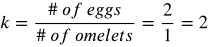
Thus, k = 2. What this means is we can determine the number of eggs by multiplying the number of omelets by 2, or the number of omelets by dividing the number of eggs by 2. No matter how many eggs or omelets there are, they will be related by this constant of proportionality. Also, because they have a directly proportional relationship, if we double the number of eggs, we also double the number of omelets; if we halve the number of eggs, we also halve the number of omelets, and so on.
 Inverse Variation
The constant of proportionality is therefore 300. Knowing the constant of proportionality between variables allows us to solve certain problems.
If it takes 20 people 15 hours to perform a task, how long will it take 28 people to perform that same task?
We know that the constant of proportionality from above is 300, and we know that there are 28 people instead of 20 people, so plugging the number of people and the constant of proportionality into the equation for inverse variation:
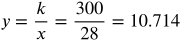
It would therefore take 28 people 10.714 hours.
..jpg)
For example, if a bowl of fruit contains one oranges and three lemons, then the ratio of oranges to lemons is one to three (1:3). For each orange there are 3 lemons.
A ratio doesn't necessarily provide the actual number of objects involved. It only tells us how much of one thing we have in relation to another thing.
For instance, if I were to tell you that I have a bowl of fruit at my house with a ratio of 1 orange to 3 lemons you wouldn't know the actual number of lemons and oranges I have. You only know that for every orange I have 3 lemons. So the actual number of oranges and lemons could be 1 and 3, 2 and 6, 3 and 9 and so on.
Ratios are generally written:
- using the word "to" (3 to 5)
- using a colon (3:5)
- as a fraction (3/5)
Parts of a Ratio

B. Part to Part vs Part to Whole
Ratios can be divided into part to part and part to whole ratios.
Part to part ratios express the relationship between two distinct groups. For example:
1) The ratio of men to women is 3 to 5.
2) The mixture contains 3 parts water for every 2 parts alcohol.
Part to whole ratios express the relationship between a particular group and the whole population to which the group belongs. For example:
1) The ratio of men to the whole group of men and women is 3 to 8.
2) The mixture is 2/5 alcohol.
If we are given a problem where a population consist of only two parts, we find that there are four ratios we can write. Let's use the example at the beginning where we have a bowl of fruit that contained one oranges and three lemons. From this we can write two part to part ratios and two part to whole ratio.
Part to part
1) The ratio of oranges to lemons is 1:3
2) The ratio of lemons to oranges is 3:1
Part to whole
3) The ratio of oranges to all the fruit in the bowl is 1:4
4) The ratio of lemons to all the fruit in the bowl is 3:4
Ratios can be divided into part to part and part to whole ratios.
Part to part ratios express the relationship between two distinct groups. For example:
1) The ratio of men to women is 3 to 5.
2) The mixture contains 3 parts water for every 2 parts alcohol.
Part to whole ratios express the relationship between a particular group and the whole population to which the group belongs. For example:
1) The ratio of men to the whole group of men and women is 3 to 8.
2) The mixture is 2/5 alcohol.
If we are given a problem where a population consist of only two parts, we find that there are four ratios we can write. Let's use the example at the beginning where we have a bowl of fruit that contained one oranges and three lemons. From this we can write two part to part ratios and two part to whole ratio.
Part to part
1) The ratio of oranges to lemons is 1:3
2) The ratio of lemons to oranges is 3:1
Part to whole
3) The ratio of oranges to all the fruit in the bowl is 1:4
4) The ratio of lemons to all the fruit in the bowl is 3:4
Fraction vs ratio
A ratio of two numbers can be written as a fraction, but may not represent the same thing a fraction does. The denominator of a fraction ALWAYS represents the number of equal parts a whole is divided into. A ratio can compare numbers with the same or different units.
C. Simplifying Ratios
The process is the same as that used to simplify fractions (see fractions)
D. Ratio Table

II. Rates
A unit rate is a way of comparing two different quantities where one of the quantities is expressed as one unit. In other words, it describes how much of one thing corresponds to one unit of another thing. We write this as a ratio with a denominator of one. Using the above example of a car that traveled 300 miles in 3 hours we would would says the unit rate is 100 miles per hour.
C. Simplifying Ratios
The process is the same as that used to simplify fractions (see fractions)
D. Ratio Table
A ratio table is a table which lists equivalent ratios.
Example: Cookies and Milk
Suppose Ben drinks 1 glass of milk for every 2 cookies that he eats. To build a ratio table for this situation, we can start with the ratio 1:2 and then multiply both the numerator (antecedent) and denominator (consequent) by the same number to generate equivalent ratios. Here’s what the ratio table would look like:

II. Rates
A. Intro
When two quantities of different units are compared and expressed as a ratio, we refer to it as 'Rate'.
Let us consider an example of a car that traveled 300 miles in 3 hours. Here, miles and hours are different units. This way of comparing two different units expressed as a single ratio is termed as 'Rate'.
Some examples of rates include
- Speed: Miles per hour (mph) when driving a car.
- Price: Dollars per gallon ($/gal) for gasoline at the pump.
- Cooking: Cups per recipe for ingredients like flour or sugar.
- Exercise: Calories burned per minute during a workout.
- Sports: Points scored per game in basketball or touchdowns in football.
Like ratios, rates are written using a colon or as a fraction but generally use the word "per" instead of "to".
-using the word "per" (100 miles per hour)
-using a colon (100:1)
-as a fraction (100/1)

B. Finding the Unit Rate
III. Proportions
A. Intro
A proportion is an equation of two ratios that are equal. For example, if one package of cookie mix makes twenty cookies then two packages would make forty. This can be expressed as:
1/20 = 2/40
A proportion is read as "x is to y as z is to w"
x/y = z/w
1/20 = 2/40
A proportion is read as "x is to y as z is to w"
x/y = z/w
B. Determining If Two Ratios Are Equal To Each Other
There are various ways to determine if two ratios are equivalent
1. Horizontal Method
Is 4/5 equal to 12/15?
If so, then we know that whatever number was multiplied by 4 to get 12 would also have to be multiplied by 5 to get 15. With this example it is easy to see that the 4 in the first numerator is multiplied by 3 to get the 12 in the second numerator. Multiplying the first denominator 5 by 3 equals the 15 in the second denominator, so we know the two ratios are equivalent. (See constant of proportionality below)
2. Vertical Method
A ratio is a relationship of two things which indicates how many times the first number contains the second. The vertical method looks to see if that relationship is the same with both ratios.
Is 3/6 = 4/8?
We start by looking for the relationship between the numerator and denominator in the first ratio by asking what do we have to multiply 3 by to get 6. It's easy to see with this example that 6 divided by 3 equals 2. We next look at the second ratio and multiply the numerator 4 by 2 and see that it does indeed equal the denominator 8. Thus we can conclude these two proportions are equal.
3. Cross Multiply

C. Solving Proportion problems
Often proportion problems are presented as a proportion with one missing variable. There are various ways to solve these problems. We will look at using the horizontal method and vertical method discussed above as well as using algebra.
1. Horizontal Method
8/36 = 10/n
If we know this is a proportion we can solve horizontally by asking, 8 times what number gives us 10? We get our answer by dividing 10 by 8. 10/8 = 1.25. Now that we know that the 8 in the first numerator times 1.25 equals the 10 in the second numerator, we multiply this same factor to the first denominator to solve for n. 36 x 1.25 = 45, so n = 45.
2. Vertical Method
8/36 = 10/n
To solve this problem using the vertical method we would ask ourselves, 8 times what number gives 36? 36/8 = 4.5. Now that we know that the 8 in the first numerator times 4.5 equals the 36 in the first denominator, we now solve for n by multiplying the 10 in the second numerator by 4.5 which equals 45, so n = 45.
3. Algebra
8/36 =10/n
To solve, we need to isolate the variable n to one side of the equation. To do this, first multiply both side of the equation by n, which results in 8/36n = 10. Next multiply both sides of the equation by 36/8, leaving you with
n = 360/8 which reduces to n = 45.
Often proportion problems are presented as a proportion with one missing variable. There are various ways to solve these problems. We will look at using the horizontal method and vertical method discussed above as well as using algebra.
1. Horizontal Method
8/36 = 10/n
If we know this is a proportion we can solve horizontally by asking, 8 times what number gives us 10? We get our answer by dividing 10 by 8. 10/8 = 1.25. Now that we know that the 8 in the first numerator times 1.25 equals the 10 in the second numerator, we multiply this same factor to the first denominator to solve for n. 36 x 1.25 = 45, so n = 45.
2. Vertical Method
8/36 = 10/n
To solve this problem using the vertical method we would ask ourselves, 8 times what number gives 36? 36/8 = 4.5. Now that we know that the 8 in the first numerator times 4.5 equals the 36 in the first denominator, we now solve for n by multiplying the 10 in the second numerator by 4.5 which equals 45, so n = 45.
3. Algebra
8/36 =10/n
To solve, we need to isolate the variable n to one side of the equation. To do this, first multiply both side of the equation by n, which results in 8/36n = 10. Next multiply both sides of the equation by 36/8, leaving you with
n = 360/8 which reduces to n = 45.
Alternatively you could use cross multiplication. 8 * n = 36 * 10. Rewritten as 8n = 360. Next divide both sides of the equation by 8: 8n/8 =360/8. The result is n = 45.
D. Constant of Proportionality
A constant of proportionality, also referred to as a constant of variation, is a constant value denoted using the variable "k," that relates two variables in either direct or inverse variation.Direct variation
Direct variation describes a relationship in which two variables are directly proportional, and can be expressed in the form of an equation as
y = kx (aka: what times x equals y)
or
k = y/x
Direct variation describes a relationship in which two variables are directly proportional, and can be expressed in the form of an equation as
y = kx (aka: what times x equals y)
or
k = y/x
where y and x are variables, and k is the constant of proportionality. Variables that are directly proportional increase and decrease together; if y increases, x increases at the same rate; if y decreases, x decreases at the same rate.
For example, the number of eggs used is directly proportional to the number of omelets a person can make, and the number of eggs and omelets are related by a constant of proportionality. Given that a recipe requires 2 eggs to make 1 omelet, we can find the constant of proportionality by plugging this into either of the equations above, where y is the number of eggs and x is the number of omelets:
Thus, k = 2. What this means is we can determine the number of eggs by multiplying the number of omelets by 2, or the number of omelets by dividing the number of eggs by 2. No matter how many eggs or omelets there are, they will be related by this constant of proportionality. Also, because they have a directly proportional relationship, if we double the number of eggs, we also double the number of omelets; if we halve the number of eggs, we also halve the number of omelets, and so on.

Inverse variation describes a relationship in which two variables are indirectly proportional, and can be expressed in the form of an equation as
y = k/x
or
k = xy
where y and x are variables, and k is the constant of proportionality. Variables that are inversely proportional have a relationship such that when one variable increases, the other decreases, and vice versa.
For example, the number of people performing a task may be inversely proportional to the amount of time it takes to complete the task. If we know that it takes 20 people 15 hours to perform a task, and that the relationship is inversely proportional, we can find the constant of proportionality by multiplying the two:
If it takes 20 people 15 hours to perform a task, how long will it take 28 people to perform that same task?
It would therefore take 28 people 10.714 hours.
E. Graphing Proportions
When graphing proportions the line will always be straight and go through the origin (0,0).
..jpg)
IV. PracticeKhan Proportional Relationships Unit
