Friday, July 1, 2016

Exponents

Exponents are a shorthand way to show how many times a number, called the base, is to be multiplied times itself. A number with an exponent is said to be "raised to the power" of that exponent.

Hence with the above example, we would say four is being raised to the second power, which means 4 x 4.

Some examples of exponents are:
  • 3 × 3 × 3 × 3 × 3 = 35
  • -2 × -2 × -2 = (-2)3

Squares and Cubes
Common exponents have their own names. The exponent 2 is referred to as "squared" and the exponent 3 is referred to as "cubed." For instance, 5 in words could be called 5 to the second power or 5 squared. 6could be referred to as 6 to the 3rd power or simply 6 cubed.


Zero Power & First Power
A number (except zero) raised to the zero power equals 1. Example 40 = 1.

A number (except zero) raised to the 1st power equals the number itself. Example, 41 = 4.

Negative Base with Positive Exponent
A negative number (negative base) with a positive exponent is simply the negative number multiplied by itself however number of times as indicated by the exponent. Following the rules for multiplying integers this means that:

If a negative number (base) is raised to a positive even power, the result is a positive number

(- 5)2 = - 5 ×- 5 = 25 

If a negative number (base) is raised to a positive odd power, the result is a negative number

(- 4)3 = - 4 × -4 × - 4 = - 64 

Negative Exponents
A negative exponents means that we take the inverse of the base and multiple it by itself the number of times indicated by the exponent.

5-4 = 1/54 x 1/54 x 1/54 x 1/54 = 1/625

If the base number is a fraction, then the negative exponent switches the numerator and the denominator.

(2/3)-4 = (3/2)4 = (34)/(24) = 81/16 

Product Rule (Multiplying exponential expressions with the same base)
When multiplying two bases of the same value, keep the bases the same and then add the exponents together to get the solution

32 x 34 = 3 2 + 4 = 36 

Quotient Rule (Dividing exponential expressions with the same base)
To divide exponents with the same base, subtract the exponents. 

34 ÷ 32 = 34-2 = 32

Power Rule (Raising exponential expressions to a power)
To raise an exponential expression to a power, multiply the expressions.

(32)3 = 32x3 = 36

Fractional Exponents


Laws (Rules) of Exponents


Practice
Prodigy: Exponent Rules: 7 Laws of Exponents to Solve Tough Equations
https://www.mathplanet.com/education/pre-algebra/discover-fractions-and-factors/powers-and-exponents
https://www.mathsisfun.com/algebra/exponent-fractional.html
https://www.cuemath.com/algebra/fractional-exponents/

Wednesday, June 15, 2016

Ratios & Proportions

I. Ratios
A. Intro
A ratio depicts the relationship between two numbers indicating how much of one thing there is compared to another thing. A ratio consists of an ordered pair of non-negative numbers, which are not both zero.

For example, if a bowl of fruit contains one oranges and three lemons, then the ratio of oranges to lemons is one to three (1:3). For each orange there are 3 lemons.

A ratio doesn't necessarily provide the actual number of objects involved. It only tells us how much of one thing we have in relation to another thing.

For instance, if I were to tell you that I have a bowl of fruit at my house with a ratio of 1 orange to 3 lemons you wouldn't know the actual number of lemons and oranges I have. You only know that for every orange I have 3 lemons. So the actual number of oranges and lemons could be 1 and 3, 2 and 6, 3 and 9 and so on.

Ratios are generally written:
  - using the word "to" (3 to 5)
  - using a colon (3:5)
  - as a fraction (3/5)

Parts of a Ratio


B. Part to Part vs Part to Whole
Ratios can be divided into part to part and part to whole ratios.

Part to part ratios express the relationship between two distinct groups. For example:
  1) The ratio of men to women is 3 to 5.
  2) The mixture contains 3 parts water for every 2 parts alcohol.

Part to whole ratios express the relationship between a particular group and the whole population to which the group belongs. For example:
  1) The ratio of men to the whole group of men and women is 3 to 8.
  2) The mixture is 2/5 alcohol.

If we are given a problem where a population consist of only two parts, we find that there are four ratios we can write. Let's use the example at the beginning where we have a bowl of fruit that contained one oranges and three lemons. From this we can write two part to part ratios and two part to whole ratio.

Part to part
  1) The ratio of oranges to lemons is 1:3
  2) The ratio of lemons to oranges is 3:1

Part to whole
  3) The ratio of oranges to all the fruit in the bowl is 1:4
  4) The ratio of lemons to all the fruit in the bowl is 3:4

Fraction vs ratio
A ratio of two numbers can be written as a fraction, but may not represent the same thing a fraction does. The denominator of a fraction ALWAYS represents the number of equal parts a whole is divided into. A ratio can compare numbers with the same or different units.

C. Simplifying Ratios
The process is the same as that used to simplify fractions (see fractions)

D. Ratio Table
A ratio table is a table which lists equivalent ratios. 

Example: Cookies and Milk

Suppose Ben drinks 1 glass of milk for every 2 cookies that he eats. To build a ratio table for this situation, we can start with the ratio 1:2 and then multiply both the numerator (antecedent) and denominator (consequent) by the same number to generate equivalent ratios. Here’s what the ratio table would look like:


II. Rates
A. Intro
When two quantities of different units are compared and expressed as a ratio, we refer to it as 'Rate'.

Let us consider an example of a car that traveled 300 miles in 3 hours. Here, miles and hours are different units. This way of comparing two different units expressed as a single ratio is termed as 'Rate'.

A unit rate is a way of comparing two different quantities where one of the quantities is expressed as one unit. In other words, it describes how much of one thing corresponds to one unit of another thing. We write this as a ratio with a denominator of one. Using the above example of a car that traveled 300 miles in 3 hours we would would says the unit rate is 100 miles per hour.

Some examples of rates include 

  • Speed: Miles per hour (mph) when driving a car.
  • Price: Dollars per gallon ($/gal) for gasoline at the pump.
  • Cooking: Cups per recipe for ingredients like flour or sugar.
  • Exercise: Calories burned per minute during a workout.
  • Sports: Points scored per game in basketball or touchdowns in football.
Like ratios, rates are written using a colon or as a fraction but generally use the word "per" instead of "to".
-using the word "per" (100 miles per hour)
-using a colon (100:1)
-as a fraction (100/1)


B. Finding the Unit Rate


III. Proportions
A. Intro
A proportion is an equation of two ratios that are equal. For example, if one package of cookie mix makes twenty cookies then two packages would make forty. This can be expressed as:

1/20 = 2/40

A proportion is read as "x is to y as z is to w"

x/y = z/w


B. Determining If Two Ratios Are Equal To Each Other 
There are various ways to determine if two ratios are equivalent

1. Horizontal Method
Is 4/5 equal to 12/15?

If so, then we know that whatever number was multiplied by 4 to get 12 would also have to be multiplied by 5 to get 15. With this example it is easy to see that the 4 in the first numerator is multiplied by 3 to get the 12 in the second numerator. Multiplying the first denominator 5 by 3 equals the 15 in the second denominator, so we know the two ratios are equivalent. (See constant of proportionality below)

2. Vertical Method
A ratio is a relationship of two things which indicates how many times the first number contains the second. The vertical method looks to see if that relationship is the same with both ratios.

Is 3/6 = 4/8?

We start by looking for the relationship between the numerator and denominator in the first ratio by asking what do we have to multiply 3 by to get 6. It's easy to see with this example that 6 divided by 3 equals 2. We next look at the second ratio and multiply the numerator 4 by 2 and see that it does indeed equal the denominator 8. Thus we can conclude these two proportions are equal.

3. Cross Multiply


C. Solving Proportion problems
Often proportion problems are presented as a proportion with one missing variable. There are various ways to solve these problems. We will look at using the horizontal method and vertical method discussed above as well as using algebra.

1. Horizontal Method
8/36 = 10/n

If we know this is a proportion we can solve horizontally by asking, 8 times what number gives us 10? We get our answer by dividing 10 by 8. 10/8 = 1.25. Now that we know that the 8 in the first numerator times 1.25 equals the 10 in the second numerator, we multiply this same factor to the first denominator to solve for n. 36 x 1.25 = 45, so n = 45.

2. Vertical Method
8/36 = 10/n

To solve this problem using the vertical method we would ask ourselves, 8 times what number gives 36? 36/8 = 4.5. Now that we know that the 8 in the first numerator times 4.5 equals the 36 in the first denominator, we now solve for n by multiplying the 10 in the second numerator by 4.5 which equals 45, so n = 45.

3. Algebra
8/36 =10/n

To solve, we need to isolate the variable n to one side of the equation. To do this, first multiply both side of the equation by n, which results in 8/36n = 10. Next multiply both sides of the equation by 36/8, leaving you with
n = 360/8 which reduces to n = 45.

Alternatively you could use cross multiplication. 8 * n = 36 * 10. Rewritten as 8n = 360. Next divide both sides of the equation by 8: 8n/8 =360/8. The result is n = 45.


D. Constant of Proportionality
A constant of proportionality, also referred to as a constant of variation, is a constant value denoted using the variable "k," that relates two variables in either direct or inverse variation.

Direct variation
Direct variation describes a relationship in which two variables are directly proportional, and can be expressed in the form of an equation as

y = kx    (aka: what times x equals y)

or

k = y/x

where y and x are variables, and k is the constant of proportionality. Variables that are directly proportional increase and decrease together; if y increases, x increases at the same rate; if y decreases, x decreases at the same rate.

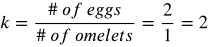
For example, the number of eggs used is directly proportional to the number of omelets a person can make, and the number of eggs and omelets are related by a constant of proportionality. Given that a recipe requires 2 eggs to make 1 omelet, we can find the constant of proportionality by plugging this into either of the equations above, where y is the number of eggs and x is the number of omelets:


Thus, k = 2. What this means is we can determine the number of eggs by multiplying the number of omelets by 2, or the number of omelets by dividing the number of eggs by 2. No matter how many eggs or omelets there are, they will be related by this constant of proportionality. Also, because they have a directly proportional relationship, if we double the number of eggs, we also double the number of omelets; if we halve the number of eggs, we also halve the number of omelets, and so on.

Inverse Variation

Inverse variation describes a relationship in which two variables are indirectly proportional, and can be expressed in the form of an equation as

y = k/x

or

k = xy

where y and x are variables, and k is the constant of proportionality. Variables that are inversely proportional have a relationship such that when one variable increases, the other decreases, and vice versa. 


For example, the number of people performing a task may be inversely proportional to the amount of time it takes to complete the task. If we know that it takes 20 people 15 hours to perform a task, and that the relationship is inversely proportional, we can find the constant of proportionality by multiplying the two:


k = xy = 20 × 15 = 300

The constant of proportionality is therefore 300. Knowing the constant of proportionality between variables allows us to solve certain problems.

If it takes 20 people 15 hours to perform a task, how long will it take 28 people to perform that same task?

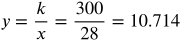
We know that the constant of proportionality from above is 300, and we know that there are 28 people instead of 20 people, so plugging the number of people and the constant of proportionality into the equation for inverse variation:


It would therefore take 28 people 10.714 hours.

E. Graphing Proportions
When graphing proportions the line will always be straight and go through the origin (0,0).


Friday, May 20, 2016

Percentages

I. Intro
Percent is a ratio or proportion per hundred (out of hundred). More simply stated, percent (per cent) means "per 100" and is expressed as a number followed by a percent sign (%).

Here is a visual representation of a grid that has 100 boxes in total of which 77 are colored. Hence, 77% of the boxes are colored.


II. Converting Between Percents, Fractions & Decimals
A. Converting Percents to Fractions
A percent is a way of expressing a fraction were the number to the left of the % sign is the numerator and 100 is the denominator. For example, 77% = 77/100. 109% = 109/100.

To convert to a fraction
1) write the percent over 100 and drop the % sign.
2) reduce if necessary.

Example:

30% = 30/100 = 3/10

B. Converting Fractions to Percents
1. The easiest way to make this conversion is to first convert the fraction to a decimal and then convert the decimal to a percentage.

1) Divide the numerator by the denominator.
2) Multiply the result by 100 (aka move decimal to the right two spaces) and add the % 

Example: Convert 3/8 to a percentage

3/8 = 0.375
0.375 x 100 = 37.5
add % sign: 37.5%

2. Another option is to convert the fraction into one with a denominator of 100, then write the answer as a percent.

1) Find a number you can multiply the bottom of the fraction by to get 100.
2) Multiply both top and bottom of the fraction by that number.
3) Then write down just the top number with the "%" sign.

Example: Convert 3/4 to a percent

4 x 25 = 100 so
3/4 x 25/25 = 75/100 = 75%

C. Converting Percents to Decimals
To convert a percent to a decimal, simply divide by 100 and remove the % sign. The result of dividing by 100 simply move the decimal 2 places to the left.

Example: Convert 30% to a decimal

Remove the % from 30%
30/100 = 0.3

or use the easy method by simply taking 30% and moving the decimal point two places to the left and removing the % sign giving you 0.3

D. Converting Decimals to Percents
To convert a decimal to a percent, simply multiply by 100 and add the % sign. Multiplying by 100 simply moves the decimal point 2 places to the right.

Example: Convert 0.125 to a percent

0.125 x 100 = 12.5
add the % sign: 12.5%

or use the easy method by simply taking 0.125 and moving the decimal point two places to the right and adding the % sign giving you 12.5%


III. Finding the Percent of a Number
To find the percent of a number, simply change the percent into a decimal or fraction, then multiply by the number.

Example: What is 18% of 150?

18% = .18
.18 x 150 = 27

or using fraction method

18% = 18/100 = 9/50
9/50 x 150/1 = 1350/50 = 27

Quick/mental percentage calculations
-Finding 100% of a number: 100% means the whole thing so 100% of a number is the number.
     100% of 91 = 91

-Finding 10% of a number: This can be quickly calculated by simply moving the decimal point of the number one place to the left.
     10% of 91 = 9.1

-Finding 1% of a number: Solve by moving the decimal point of the number two places to the left.
     1% of 91 = 0.91

-Finding 50% of a number: As 100% is a whole, 50% is half the number.
     50% of 91 = 45.5

-Finding 20% of a number: First find 10% of the number, then double the number.
     20% of 91 = 10% of 91 times 2 = 9.1 times 2 = 18.2
     Or 
   
IV. Percentage Change
Percentage change is the relative change between an old value and its new value, expressed as a percentage of the old value

The process for finding percentage change is:
1. Subtract the old value from the new value.
2. Divide this by the old value
3. Convert to a percentage (Multiple by 100 and add the % symbol) 

% change = [(new value - old value)/old value)] x 100

Example 1:
A pair of socks went from $5 to $6, what is the percentage change?

Step 1: $5 to $6 is a $1 increase
Step 2: Divide by the old value: $1/$5 = 0.2
Step 3: Convert 0.2 to percentage: 0.2×100 = 20% rise

Tuesday, February 23, 2016

Decimals: Division

I. Algorithm for Dividing Decimals
Long Division of Decimals
To divide decimals:
1) Set the problem up in long division format.
2) If the divisor is not a whole number move the decimal point in the divisor all the way to the right. Then move the decimal point in the dividend the same number of places to the right.
3) Divide as usual.
4) Position the decimal point in the result directly above the decimal point in the dividend.

Example:
Divide 10 by 0.5

Arrange the problem into the long division format.
       ____
  0.5) 10

Move the decimal point in the divisor all the way to the right making it a whole number. Move the decimal in the dividend the same number of places to the right.
   _____
 5) 100.

Divide 5 into 100.

       2   
 5) 100.
     -10

       20 
 5) 100.
     -10

Example:
Divide 48.65 by 3.5 

Arrange into long division format.
     ______
3.5) 48.65

Move the decimal point in the divisor all the way to the right making it a whole number. Move the decimal in the dividend the same number of places to the right.
    ______
35) 486.5

Divide. Place the decimal point in the answer above the decimal point in the dividend.

        13.9
35) 486.5
     -35
      136
    -105
       315
     -315
         0


II. Conceptual Understanding
1. Decimal divided by whole number
Number Line
Example: 

0.6 ÷ 2

Using the partitive model of division we can translate to "After dividing 0.6 into 2 groups, how much is in each group?"


We can visually see that splitting 0.6 into two groups gives us 0.3 in each group.

0.6 ÷ 2 = 0.3

Base Ten Blocks
Khan: Dividing a decimal by a whole number with fraction models

2. Whole number divided by a decimal
Base ten blocks
Example:

3 ÷ 0.75

Using the quotative model of division we can translate this to " How many 0.75 are contained in 3?


Using base ten blocks we can visually see that there are 4 groups of 0.75 in 3

3 ÷ 0.75 = 4

Number line

3. Decimal divided by a decimal
Example

0.75 ÷ 0.25

Using the quotative model of division  we can translate this as "How many 0.25 are in 0.75?"

The number 0.75 is marked with a red box. We want to know how many 0.25 are in 0.75. We can see there are three jumps of 0.25 so the answer is 3.

0.75 ÷ 0.25 = 3

Putting the problem into the form of a word problem can help with conceptual understanding. "A ribbon is 0.75 centimeters long. If each small piece of ribbon must be exactly 0.25 centimeters in length, how many small pieces can be cut from the ribbon?" When framing the problem this way it becomes immediately clear what the answer is. 
 
4. Reframing The Problem
-The quiz following this video really reinforces this idea


III. Miscellaneous
A. Dividing Whole Numbers That Result In Decimal Quotients
1. Dividend Not an Exact Multiple of the Divisor (Whole Number Remainders)

2. Dividing a Smaller Number by a Larger Number
When dividing a smaller whole number by a larger whole number the result will be a decimal number. 


Monday, February 22, 2016

Decimals: Multiplication

I. Standard Decimal Multiplication Algorithm  

To multiply decimals:
1) Place the numbers in vertical form lining up the numbers on the right. Do not align the decimal points.

2) Multiply as you would when multiplying whole numbers. Ignore the decimals at this point.

3) Count the number of digits after the decimals in the numbers being multiplied and move the decimal point over that many spaces from the right in the answer.


Example: Multiply 12.26 x 2.5

Place the numbers in vertical form lining them up on the right.

  12.26
x    2.5

Multiply as you would normally multiply whole numbers. At this point ignore the decimals.

     12.26
   x    2.5
      6130
+  24520
    30650

Count the number of digits after the decimals in the numbers being multiplied and move the decimal point over that many spaces from the right of the answer.

     12.26 (2 decimal places)
   x    2.5 (1 decimal place)
      6130
+  24520
   30.650 (3 decimal places starting from the right)


II. Conceptual Understanding
1. Whole number times decimal number
Number Line
Example

4 x 0.3

Thinking in terms of repeated addition we are asking "what is the total of 4 groups of 0.3?" 


4 x 0.3 = 1.2

2. Decimal number times whole number
Number Line
Example 

0.3 x 4 

Thinking of this problem in terms of scaling we are asking what is three tenths of four. To solve using the number line, we first divide the number line into tenths. 4 ÷ 10 = 0.4 so each tenth of the number 4 is 0.4 which is how the number line is partitioned. Finally we count the parts. We need three of the tenth sized parts (0.3 of the whole)


0.3 x 4 = 1.2

3. Decimal number times decimal number
Number Line
Example

0.4 x 0.3

We can word this problem as asking " what is four tenths of three tenths?" But how do we figure that distance from 0 to 0.3? I asked myself "what is one tenth of 0.3?" That would be 0.03. So I need to make 4 jumps of 0.03 to find my answer. 
0.4 x 0.3 = 0.12    


Practice
K5 Learning: Multiplication of Decimals


Reference
Master Math: Basic Math and Pre-Algebra
Math.com: Multiplying Decimals


Tuesday, February 16, 2016

Decimals: Addition & Subtraction

I. Standard Algorithm

To add or subtract numbers with decimals:
1) Place the numbers in vertical form with the decimal points aligned.
2) Add or subtract each column of numbers the same as you would add or subtract whole numbers.
3) Place the decimal point in the answer directly below the decimal point in the terms.

Example: Add 8.53 + 15.2

Write the numbers in vertical form with the decimals aligned. You can add zeros to fill empty spaces.

     8.53
+ 15.20

Add as you would normally add whole numbers and place the decimal in the answer directly below the decimal point in the terms.

     8.53
+ 15.20
   23.73

Example: 95.2 - 23.15

Write the numbers in vertical form with the decimals aligned. You can add zeros to fill empty spaces.

   95.20
-  23.15

Subtract as you would normally subtract whole numbers and place the decimal in the answer directly below the decimal point in the terms.

        1 10
   95.20
-  23.15
   72.05

II. Conceptual Understanding
Base Ten Blocks


Monday, February 15, 2016

Decimals

I. Intro
Decimals are numbers that are written with a decimal point. The number to the left of a decimal point is a whole number (or integer) and the number to the right is a fractional number (number between 0 and 1). This fractional part uses base 10 place value.

Hence, writing numbers with decimals (decimal notation) is another way of writing fractions and mixed numbers.

Reading Decimal Numbers
There are two ways to read a decimal number. 

1. Digit-by-Digit 
The first way is to simply read the whole number followed by "point", then to read the digits in the fractional part separately. It is a more casual way but more common way to read decimals. For example, we read 85.64 as eighty-five point six-four. 

2. Place Value Reading
The second way is to read the whole number part followed by "and", then to read the fractional part in the same way as we read whole numbers but followed by the place value of the last digit. For example, we can also read 85.64 as eighty-five and sixty-four hundredths. 

This method can be confusing so let's work through it.
12.1 - Twelve and one tenth
12.12 - Twelve and twelve hundredths
12.123 - Twelve and one hundred twenty three thousandths
12.1234 - Twelve and one thousand two hundred thirty four ten thousandths
12.12345 - Twelve and twelve thousand three hundred forty five hundred thousandths
12.123456 - Twelve and one hundred twenty-three thousand four hundred fifty-six millionths


II. Conceptual Models
Number Line
We can use the number line to help conceptually make sense of decimals. Here we are asked to find 0.6 on the number line. To do so, we divide 0 to 1 into ten parts. Next, we move from 0 to the right counting six places till we get to 0.6.


Area Model
Decimals can also be graphically represented with the use of an area model. The whole block is divided into 100 parts with the 35 blue colored blocks representing the number. 

III. Place Value
Place value with decimal numbers can be thought of as an expansion of the place value explanation used with whole numbers. Numbers are written using digits 0 through 9 with the position of the digit in the number determining the value of the digit. Each place has a value 10 times the place to its right. For example, the number 364.314 in expanded form is:

3 x 100 + 6 x 10 + 4 x 1 + 3 x 1/10 + 1 x 1/100 + 4 x 1/1,000

or

3 Hundreds + 6 Tens + 4 Ones + 3 Tenths + 1 Hundredths + 4 Thousandths

Here is an image showing place values of both whole and decimal number parts.


Lets focus on the digits to the right of the decimal. Each of these place units refer to a whole divided into equal parts. So the tenths place is a whole divided into ten equal parts, the hundredths is a whole divided into a hundred equal parts, the thousandths is a whole divided into a thousand equal parts, and so on.

Here are examples of equivalent forms of decimals and fractions for the place value units to the right of the decimal point in the chart above:

Tenths: 0.1 = 1/10
Hundredths: 0.01 = 1/100
Thousandths: 0.001 = 1/1,000
Ten Thousandths: 0.0001 = 1/10,000
Hundred Thousandths: 0.00001 = 1/100,000
Millionths: 0.000001 = 1/1,000,000

10 Times Relationship
The following graphic helps drive home the point that the relationship between any two adjacent places is that the place on the left is worth ten times as much as the place on the right, and the place on the right is worth one tenth as much as the place on the left:
Face Value x Place Value
Another important idea in our base ten system that extends to decimal numbers is that the quantity represented by a digit is the product of its face value and its place value. The face value is the value of the digit without regard to its position. In the number 73.6, the quantity represented by the 7, for example, is its face value 7 multiplied by its place value 10, which is 7 x 10 = 70. The face value 3 is multiplied by it's place value 1, which is 3 x 1 = 3  The face value of the 6 is multiplied by it's place value of 0.1 (or 1/10), which is 6 x 0.1 = 0.6. 

The result is 7 x 10 + 3 x 1 + 6 x 0.1 = 73.6

Regrouping With Decimals

IV. Types of Decimals
Decimals can be divided into different categories.

Terminating decimals: Terminating decimals mean it does not reoccur and end after a finite number of decimal places. For example: 543.534234

Non-terminating decimals: It means that the decimal numbers have infinite digits after the decimal point. For example, 54543.23774632439473747... 
The non-terminating decimal numbers can be further divided into 2 types:

1) Recurring (Repeating) decimal numbers: In recurring decimal numbers, digits repeat after a fixed interval. For example, 94346.374374374...

2) Non-recurring decimal numbers: In non-recurring decimal numbers, digits never repeat after a fixed interval. For example 743.872367346...

V. Conversions 
A. Converting Terminating Decimals to Fractions
Place the number to the right of the decimal point in the numerator. Next, place the number 1 in the denominator and then add as many zeroes as the numerator has digits to the right of the decimal. Reduce if necessary

Example:

5.025 = 5 .025/1 = 5 25/1000 = 5 1/40

B. Converting Repeating Decimals to Fractions
See:
Cliffnotes: Changing Infinite Repeating Decimals to Fractions
Note: Non-recurring, non-terminating decimals can not be converted to a fraction.

C. Converting Fractions to Decimals
Convert fractions to decimals by dividing the numerator by the denominator.

Example:
                                            .5 
1/2 = 2) 1    = 2) 1.0   = 2) 1.0
                                           1.0
                                           0 0

D. Converting Decimals to Percentages & Converting Percentages to Decimals
See Percentages


Practice:

Tuesday, February 9, 2016

Multiplying Fractions (And Scaling)

I. Standard Algorithms
A. Multiplying Fractions Algorithm 
To multiply fractions:
1. Multiply the numerators to get the new numerator.
2. Multiply the denominator to get the new denominator.
3. Simplify the result if necessary.

Example:


B. Multiplying Mixed Numbers
To multiply mixed fraction:
1. convert to improper Fractions
2. Follow the general algorithm for multiplying fractions (above). 
3. Convert the results back to mixed fractions.

II. Conceptual Understanding
1. Whole number times fraction (Fraction times whole number)
Number Line
To grasp the concept, we start with multiplying a whole number times a fraction.

Example 1:

4 x 2/3

We could think of this problem in terms of repeated addition where we are asking, 'what is the total of 4 groups of 2/3'? To demonstrate this, the following number line shows each number 1 through 4 divided into three equal parts as reflected by the denominator in 2/3. Starting at zero, we move to the right 2 one third units (represented by the numerator) 4 times. This leaves us at 8/3 or 2 2/3.


solving using the rules of multiplying fractions:

4 x 2/3 = 4/1 x 2/3 = 8/3 = 2 2/3

Alternatively, instead of thinking of the problem as 4 groups of 2/3, we could also have thought of it as asking 'what is 2/3 of 4'.

Example 2:

2/3 x 4

This number line shows 4 divided into three equal parts (4 ÷ 3 = 4/3 = 1 1/3). Starting at zero, we move to the right 2 of those 4/3 units ending at 8/3 = 2 2/3.
*Note: Dividing 4 into 3 parts equals 1.333.. which equals 1 1/3. It would have been much clearer to mark the first jump as 1 1/3 then the second as 2 2/3. Instead I marked each jump as 4/3 as a movement of 4/3. Just realize that  4/3 + 4/3 + 4/3 = 12/3 = 4.

2. Fraction times fraction
Number Line
Example 3:

3/4 x 1/2

We can think of this problem as asking 'what is 3/4 of a 1/2' or, since we are using the number line, we can read it as '3/4 of the distance to 1/2.' We first draw a number line which shows 1/2 of 1.

Next, we are going to figure what is 3/4 of this 1/2. To do this, we divide the 1/2 into four equal sections as indicated in the denominator of the first fraction. We can now visualize the distance, but we don't know the actual length of this distance in terms of the whole from 0 to 1. To figure this, divide the other 1/2 of the line also into four parts. Now, the entire whole from 0 to 1 has been divided into 8 parts. Finally, starting at 0 we move three of these units to the right ending on 3/8.


Also see: 
Khan: Multiplying 2 Fractions: Number Line


III. Multiplication as Scaling
As examples 2 and 3 above illustrate, the idea of multiplication as repeated addition doesn't work very well as a concept when multiplying fractions. It's at this point that some educators introduce the idea of multiplication as scaling. 

To scale a number is to make it larger or smaller by a certain factor. The concept is taught in geometry where an object is enlarged or reduced by a certain magnitude but still retain it's shape. Conceptually, repeated addition only allows you to think of multiplication as an operation that makes things bigger. The benefit of thinking of multiplication as scaling is that you can conceptually also see multiplication as a process of making a number smaller.

A good definition I came across is from the book "Putting Essential Understanding of Multiplication and Division into Practice"

“multiplication is a scalar process involving two quantities, with one quantity -the multiplier – serving as a scaling factor and specifying how the operation resizes, or rescales, the other quantity – the multiplicative unit. The rescaled result is the product of the multiplication.”

As the above definition indicates, one number of the factors in a multiplication problem is viewed as a scaling factor and the other number is seen as the number being scaled up or down. Some tutorials I've seen refer to the first number as the scaling factor and some refer to the second number as the scaling factor. Ultimately it doesn't matter given the commutative property off multiplication but I will stick to what is generally taught when multiplying whole numbers. That being the first factor is the multiplier (scaling factor) and the second number is the number being multiplied (the multiplicand) 

Example 2 (above) 

2/3 x 4 

The 2/3 is the scaling factor. Since it is less than 1 we know the answer will the less than 4. The multiplicand, 4, is being scaled down. 

Example 3 (above)

3/4 x 1/2

Again, the scaling factor, 3/4, is less than 1 so we know the answer will be less than 1/2.


Scaling
Multiplication as Scaling
Does the order of multiplicand and multiplier matter in a multiplication equation?

Friday, January 29, 2016

Adding & Subtracting Fractions

I. Standard Algorithms 
A. Adding and Subtracting Like Fractions
Like fractions are fractions that have the same denominator. To add or subtract like fractions, simply add or subtract the numerators and place the answer over the common denominator.

Examples:

3/6 + 2/6 = 5/6

12/15 - 3/15 = 9/15


B. Adding and Subtracting Unlike Fractions
(Learn to multiply fractions first)
To add or subtract fractions with different denominators, they first must be changed so that they have the same denominators. To do this:

1. Find the Least Common Denominator (LCD): Determine the smallest common multiple of the denominators. (To find the Least Common Denominator, simply list the multiples of each denominator until you find the smallest number that appears in each list.)

2. Convert each fraction: Rewrite each fraction as an equivalent fraction with the LCD as its new denominator. To do this, multiply both the numerator and the denominator by the same number that makes the denominator equal to the LCD.

3. Add or subtract the new numerators: Once both fractions have the same denominator, add or subtract their numerators as you would with like fractions.

4. Simplify (if necessary): Reduce the resulting fraction to its simplest form

Example:

1/5 + 1/6

First, find the least common denominator.

Multiples of 5: 5, 10, 15, 20, 25, 30, 35, ...
Multiples of 6: 6, 12, 18, 24, 30, 36, ...

Now convert the original problem into fractions with the common denominator. To do this multiply each original fraction by a fraction that has the same numerator and denominator, which will result in a new fraction that has the common denominator we seek.

To convert 1/5 so that it has a denominator of 30, multiply the fraction by 6/6.

1/5 x 6/6 = 6/30

To convert 1/6 so that it has the denominator of 30, multiply the fraction by 5/5.

1/6 x 5/5 = 5/30

Now simply add the new like fractions.

6/30 + 5/30 = 11/30

II. Adding and Subtracting Mixed Numbers
There are two methods of adding and subtracting mixed numbers.

Adding/Subtracting the Whole Numbers and Fractions Separately
1. If dealing with unlike fractions, find the least common denominator, then increase the terms of each fraction so that the denominator of each equals the LCD (see adding and subtracting unlike fractions above).
2. Add or subtract the fractions and add or subtract the whole numbers.

*The biggest weakness with this method is that sometimes you have to borrow. In a problem like 5 1/4 - 2 3/4, you can't just subtract the fractions. You have to "borrow" from the 5, turning it into 4 5/4. This is where students get confused. 

Converting the Mixed Numbers to Improper Fractions and Adding/Subtracting
1. Convert the mixed numbers into improper fractions.
2. If they are unlike fractions, find the least common denominator, then increase the terms of each fraction so that the denominator of each equals the LCD (see adding and subtracting unlike fractions above).
3. Add or subtract the fractions.
4. Convert your answer back into a mixed number.

*This is the method I generally use as it avoids issues with borrowing. 

Adding Mixed Numbers with Regrouping - Khan Academy Video
Subtracting Mixed Numbers with Regrouping - Khan Academy Video


III. Conceptual Understanding
Area Model (Like Fractions)
Adding and subtracting like fractions can be illustrated using an area model.

Example: 2/6 + 3/6


Example: 3/4 - 2/4


Area Model (Unlike Fractions)
An area model can be a useful representation of the process used to add or subtract unlike fractions.

Example: 2/3 + 1/4


Visually you can see that an individual piece from the first square is larger than an individual piece from the second square, so you can't treat them as if they were the same and just add them together. 

We proceed by finding the least common denominator of the two fractions, which in this case is 12. To convert 2/3 to a fraction with 12 as the denominator, we multiply it by 4/4 (We can do this because of the identity property of multiplication which states that any number multiplied by 1 remains unchanged). To convert 1/4 to a fraction with a denominator of 12, it is multiplied by 3/3. You can see this conversion illustrated in the middle two squares. 

Now that the fractions have the same denominators, they can be easily added.

IV. Miscellaneous
A. Simplifying Before You Add
While it's important to simplify your final answer, it is also sometimes easier to solve a problem by simplifying the initial fraction first.

Example:
5/10 + 2/8

Instead of finding a common denominator for 10 and 8 (which is 40), you could reduce them to 1/2 + 1/4, making the common denominator smaller (4).


Practice:
IXL: Add and subtract fractions with like denominators
IXL: Add and subtract mixed numbers with like denominators
IXL: Add and subtract fractions with unlike denominators
IXL: Add mixed numbers with unlike denominators
IXL: Subtract mixed numbers with unlike denominators